geek

Hat Headshot

The Joy of WisCon

0

This weekend I had the absolute pleasure of attending WisCon, a feminist science fiction convention in Madison, WI. Last year was my first WisCon, and I knew very early into the con that I’d be coming back. WisCon has a strong academic thread as well as a clear social justice orientation, in addition to being a SF/F writing convention. Plus, Madison is a great city, the hotel is in the middle of a great cluster of restaurants downtown, and I have local friends to visit.

This year I had even more fun than the first time. I’ve been to a number of conventions over the years, and it always takes me a few hours to rev up, but once I get going, I’m in full extrovert geek mode, happy to meet new people and wax geeky.

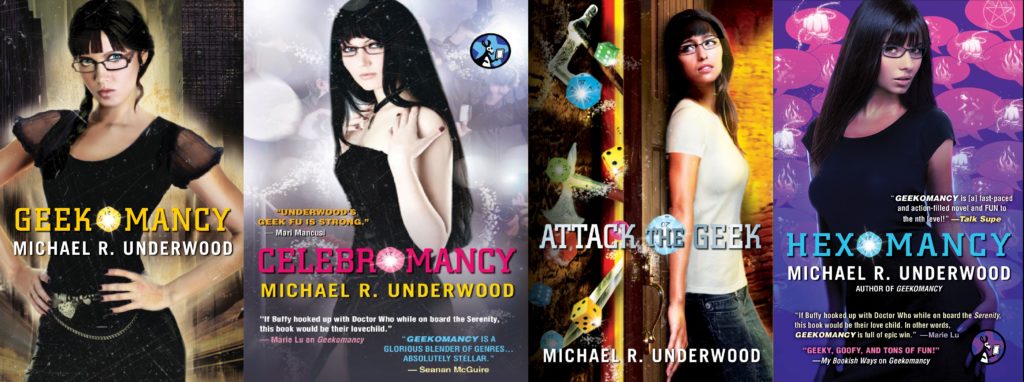
I had the chance to participate in programming this year, thanks to the quick work of the convention committee and the generosity of the Exotic Worlds group: Bradley P. Beaulieu, Holly McDowell, Derek Silver, and LaShawn M. Wanak. I read from chapter two of Geekomancy, and was very happy that the time I spent on preparation paid off.

Since I’ve been performing nearly my whole life, between choir, dance, and various RPGs (tabletop and LARP), I do my best to make sure that my public readings are performances, with notable value added. If I just read what is written, I wouldn’t be adding anything new. But since I have that experience, and love a crowd, I try to use those skills and inclinations as a benefit. Word on the street is that there are far fewer book tours these days in U.S. publishing, where only a small handful of authors for each publisher are supported with funds for in-person tours across the country. By developing my reading performance skills now, I can try to make a reputation as an entertaining reader…and if that leads to

The reading went very well, I think, since I was happy with it and I got good feedback over the weekend from folks that were there.

This was also my first convention after selling Geekomancy and sequel, so it was all fresh and new to be a bona fide author, with a novel coming very very soon. I had a great time talking about Geekomancy but tried not to toot my horn too often or too loudly. No one wants to listen to the writer that turns every conversation into an extended commercial for their books. I love the conversations that pipe up at conventions, from craft to life, tips to tales of publishing mishaps small and large. Conventions are where I go to bask in the awesome of the SF/F community, who are some of my favorite people in the world.

Even as I was leaving, I started yearning for the next WisCon. Each convention has its own flavor, its own feel, and it can change from year to year (especially conventions that change locations each year, like the World Fantasy Convention). But WisCon was and will likely remain one of my absolute favorites.

World Fantasy 2011

0

I got back from World Fantasy late last night.

This was the fourth WFC that I’ve been to, and the third in a row, following San Jose and Colombus.  This year the con was in San Diego, which was pretty good for temperature, but it was dry as hell (maybe not hell, but dryer than the midwest).

This World Fantasy was a big one for me: I performed my first two fiction readings at a convention, with a personal reading and participating in a group reading.  I also pitched Shield & Crocus to a couple of editors and spent good time talking and brainstorming with client publishers Night Shade Books, Prime Books, and ChiZine Publications.

Reading:

My reading was in the first programming slot on Thursday (3pm) which turned out to be great, since many of my friends/colleagues from the Codex Writers Group were in attendance, as well as some personal friends (Scat Hardcore in the house!).  I rehearsed last weekend and got feedback from my brilliant girlfriend Meg, and was prepared to bring the awesome.  I read most of the first chapter of Shield & Crocus, since I’d just finished the big revision, had it fresh in my brain, and wanted to push the novel to help with things like pitching to agents/editors and such.

Thanks to practice, and my years of training as a performer (gamer, dancer, singer, sales rep), it went marvelously.  I had sound effects and robot voices.  I realized just after banging the wall behind me that maybe the people on the other side of the wall might be disturbed, but no one complained and it had a great effect on my audience.  I’m very happy with that as the first of many public readings in my career.  The group reading went well also, though I had barely 5 minutes due to a scheduling mishap.  There I read from “Last Tango in Gamma Sector,” and didn’t have enough time to get to the emotional breakup scene, but the audience seemed to be amused by the awesomeness of tango-piloted starships.

Social:

Each year, socialization gets easier for me at WFC, since my circles of friends and acquaintances grow after every convention.  Most delightful was seeing my friends from Bloomington, the Scat Hardcore crew who have scattered to the four winds, off to the Bay Area, Delaware, and the Big Apple.  The five of us had dinner on Saturday, and it was lovely.  Second best was continuing to hang with the Codex Writers posse, meeting new people and re-connecting with others.

Professional:

I wear two hats at World Fantasy:  Writer and Sales Rep.  Having the sales-side experience has been great for my ability to contribute to conversations and present myself as a publishing professional, since I have something that lets me stand out from other aspirant and neo-pro writers.  I met several folks on the Night Shade Books staff that I’d communicated with through email but hadn’t talked to in-person, which was great, since my gig on the sales side involves working with people in all departments of a publishing house: editorial, publicity, marketing, sales, and so on.  I also met the main editor for Prime Books, and chatted with the Prime folks on strategy and publishing trends.  I got to check in with the folks at ChiZine Publications as well, and am very excited for their upcoming titles as well as their World Fantasy Award nomination (they didn’t end up winning, but even a nomination is a big honor for any press).

The big win on the writer side was that I’d decided to try to find opportunities to pitch Shield & Crocus to editors, and managed to do so twice, each with presses that have put out work that I greatly admire.  I think either could be a good home for the novel, and I’m looking forward to their responses.

Write-a-Thon Week One

0

As I previously mentioned, I’m participating in the Clarion West Write-a-Thon, which runs concurrently with the 2011 workshop in Seattle.

My first story for the Write-a-Thon is “Can You Tell Me How To Get…”, a post-apocalyptic cyberpunk muppet story.  Yeah, that’s right: muppets.

We’ve hit our participant goal, now we’re looking for sponsors to support one or more writers while we toil away for the next six weeks, sculpting awesome out of pure nothing, fueled by caffeine, madness, and whatever other sins the various writers use for inspiration.

Here’s a short teaser from the story-in-progress:

“Can you tell me how to get to Paprika Place?” Charlie would ask.  The ones that remembered him from their TV days would shake their heads politely.  They’d been viewers once, tuning in every afternoon to learn their letters and numbers.  The younger ones, or the ones whose parents had worked for The Mouse or CapeCo, who’d been forbidden to watch Bunco’s shows, they would just recoil from Fluffasaurus and run back to their houses.  Then the guards would come in their sharp black suits and sunglasses and ask him to move along.

Remember kids, don’t talk to strangers!

One Week With My HTC Flyer

0

I’d been nibbling around the edges of the tablet world since late last year, trying to figure out when to get one, what to get, whether it’d be good to buy now or if I should wait…all of that.

While I have an iPhone and it works great, I’ve been less and less happy about Apple’s behavior with regards to their mobile devices and app store.  They’ve engaged in a fair bit of censorship, are trying to restrict third party’s ability to conduct commerce inside of apps used on their devices, and are very very protectionist of their devices, with crazy EULAs and such things.  They’re protecting their very valuable IPs, and trying make money, which is fine.  But I decided that if I could get a tablet and have it not be an iPad, while still doing the things I wanted it to, I’d be happy.

Here’s what I wanted out of a tablet:

  • Something that can play audio and video, with good playlist and sorting
  • Access to the burgeoning tablet/touchscreen video game market (as a player)
  • eBook reading capability (with a bigger screen than my little iPhone).
  • A larger storage capacity, so I could shift much of the mobile music burden from my phone (which burns down its battery very fast).
  • Something sturdy — since I travel a lot and can be rough on my tech.
  • A device that would work with a stylus, especially as handwriting recognition tech increases.
  • It must look cool and have an intuitive GUI, while still leaving me with a lot of control over the device.
I did a fair amount of scouting, looking at the iPad 2, the Motorola Xoom, as well as previews of the HP TouchPad and this thing called the HTC Flyer.  HTC’s reputation is mostly as a smartphone company, but their proprietary GUI (Graphic User Interfase) is very cool, and I saw that a WiFi 7″ tablet with stylus add-on was coming from Best Buy.
I picked mine up in NYC a little over a week ago, and am only now getting it into fighting shape, since I’ve been on the road since the 20th and hadn’t been able to spend serious time getting a handle on how best to use the Flyer.
First Impressions:
  • The real price of the Flyer is $580, because the stylus was broken out into an accessory.  This let Best Buy advertise the device at $500, when it really needs the stylus to do all of what it can do.  Kind of annoying, but that’s something to blame on Best Buy, not HTC.
  • The Flyer has a good heft to it, and feels fairly sturdy.
  • I’m still getting used to the HTC Sense version of Android, but it makes a bit more sense every day.  I have a lot more control and fiddly power with this than I would with an iPad.  And I like to fiddle.
  • AirSync and DoubleTwist are brilliant.
  • The crucial feature that makes the Flyer a great work asset is the fact that I can use the stylus to ‘write’ in my publishers’ catalog pdfs or order sheets, and save them/send them to myself.  This should be huge, and save a lot of paper.
  • I screwed up applying the ZAGG shield, and now I have to figure out if there’s a way to salvage it (there is dirt on the sticky side, so all sorts of flecks show on the screen) or if I just need to buy another one and get it professionally installed (which would be annoying, and waste the $$ I spent on the first shield).
  • My hope is that having the Flyer will let me drain my phone battery much less frequently when on the road, so I don’t have to re-charge while driving or risk shutdown.
  • More to come as I learn the ropes of this nifty, vote-my-politics-with-my-money device.

WisCon — Changing Science Fiction With Bake Sales

0

This weekend, I became a member of the Secret Feminist Cabal, with insidious plans to take over the world and indoctrinate the masses…with Feminism.

I’d been hearing about the awesomeness of WisCon for years, from writer friends, scholar friends, and complete strangers.  I intended to go last year, but plans fell through.

This year, I made it a priority and finally reached the nerdy casual halls of the Concourse Hotel and Governor’s Club in Madison, WI.  I flew directly from having been in NYC for a week (working, including BEA), so I had a wicked-overpacked bag.  We had a six-hour delay getting out of LaGuardia, and I was very happy to have my various gadgets and some books on hand for distraction.

I could spend quite a long time talking about how awesome WisCon is, but I think I will start with a bullet point approach.

  • Starting off the convention with a writing workshop, getting great feedback on the opening of Shield & Crocus.
  • Getting to see friends from far away, catching up with @Teleidoplex, @futuransky, @DougHulick, @CassieY4, @creature57, @rachelswirsky and many others
  • A convention where the default level of discourse is high enough that when I ramble about the ideological implications of semiotic paradigms, people nod instead of making confused or annoyed faces
  • Bake Sales for Activism
  • A riotous auction filled with communitas
  • Great readings from brilliant writers.
  • Meeting several of my authors (for Night Shade Books and Prime Books)
  • Acquiring several books and only having to pay for two.
  • Discovering delicious food in downtown Madison, from tapas to pizza to Himalayan food
  • My awesome roommates @Keffy and EJ — we all worked excellently together and helped me have a Con Posse despite never having been to WisCon
  • Rar and Squee in various amounts across the weekend, with cutting critiques and effusive praise
WisCon has been going on for thirty-five years, and as such, has an incredible amount of history, in-jokes, and a lovingly-curated feel of inclusiveness, plurality of voice and perspective.  Unlike pretty much any other convention I’ve ever been to, the gender balance was possibly up to 2:1 women:men — making for a very different feel.
I’m excited to attend again next year, and I’d love to be able to do a reading (especially if I have more sales by then).  I think WisCon and World Fantasy are a great pairing of conventions for me, one more formal and ‘professional’, the other more informal and more academic.  If possible, I’d like to hit even more conventions, but that will come down to budgeting and time negotiation between the SCA and writing conventions.
Next post:  Week One with my HTC Flyer.

Re-Launch — Now “Geek Theory”

0

I’ve decided to re-vise, re-name, and re-launch this blog as “Geek Theory.”

Since I’ve been focusing more on my fiction and my ambitions as a writer of speculative fiction, I’m re-branding this WordPress blog as my personal-professional blog, talking about writing, my life as an independent publishers’ book rep, and other fun things.  There will be far fewer reviews and essays, and they’ll be in a more personal tone, rather than my pop-academic tone from before.

First up — a summary post on the awesome that was WisCon 35.

Noise by Darin Bradley — Abhorrent & Fascinating

0

One of my recent reads was Noise, by Darin Bradley.  This book got lots and lots of buzz when it came out (at least online), but it wasn’t until last month I picked it up, as my original response was ‘that sounds like I’d hate it.’

Turns out that response was correct, just not in the way I’d expected.

The book is all filtered through the perspective of one disaffected youth, with his life-long BFF at his side.  These guys grew up playing D&D, playing boffer swordfighting, and learning survival skills in scouts.  So when the digital changeover leaves a gap of frequencies that pirate broadcasters hijack to share their apocalyptic warnings, the boys listen.  They start planning, preparing, assembling their own ‘how to survive the apocalypse’ manual, a manual that assumes violence.  Not just violence to survive, but lots of violence, as a primary tool of obtaining what you want.

Noise is a book about the ways that personal mythology can be used to completely transform your thinking, and how cultural narratives and groupthink can be used to justify all sorts of horrible acts.

The book is far easier to understand just by reading it.  I found that as much as I deplored what was going on in the book, it was compellingly told, and I could imagine that there would be no small number of people who, in the event of a collapse as described (sketchily, I’ll add — either viewable as a bug in the book or a feature if you think that the main character doesn’t really care about the collapse, just the response), would go off the deep end like that.

It’s not an easy book to read, and it is not a clear condemnation or valorization of geeks, boy scouts, or anarchists.  It is, instead, a fascinating character study of how a pair of suburban boys try to transform themselves into the kind of people who can survive and thrive in an apocalypse and post-collapse world.

Reality is Broken (review/essay/gushing)

3

I think my life has just been changed by a book again. The last book that blew my mind this much was Henry JenkinsConvergence Culture.  I’m not counting novels right now, because fiction and non-fiction blow my mind in such different ways.  This kind of mind-blowing is the one that is potentially career-changing (I want a career as a writer, but other careers along the way might be useful to pay the bills).  More organized thoughts may come later, but right now I want to share my enthusiasm and talk briefly about some exciting things.

The author of Reality is Broken: Why Games Make Us Better And How They Can Change The World is Jane McGonigal, whom you might know from her TED Talk:

[ted id=799]

Reality is Broken is a continuation of the thread of logic that McGonigal puts forward in the TED talk and in support of her biggest dream: she wants to see a game designer win the Nobel Prize for Peace by 2032.

The book is a concerted effort to take a reader through many of the corners of game design and to show off each area’s lessons, and presents a paradigm which enables every person on earth to participate in saving the planet and the human race: Games.  Gamers, she says, are humanity’s secret weapon in our struggle to survive, thrive, and protect our planet.

Disclaimer: I’m a life-long gamer.  Some of my earliest memories are playing computer games on my dad’s lap, as we pushed our Commodore Amiga to its limits with games like Romance of the Three Kingdoms, Land of the Rising Sun, and more.  I started playing D&D when I was eight, Magic: the Gathering when I was 11, and so on.  I was too young to be a part of the first video-gamer generation, but I am totally a representative of the 2nd-gen gamer.  From what I can tell, this book is written in no small part to people like me, lifelong gamers, as an inspiration and challenge to go out in the world and turn our gaming experience to achieve Epic Social Win.  And for this gamer, the inspiration has certainly been successful.

It’s actually somewhat difficult for me to talk about this book, for several reasons.  For one, it’s got a crapton of material and ideas contained within.  McGonigal puts forward fourteen ‘fixes’ for reality based on various ways that gaming is superior to reality in letting us be more optimistic, more connected, more engaged and so on.

Here’s Fix#1, from p.22:

“Fix #1: Unnecessary Obstacles

Compared with games, reality is too easy.  Games challenge us with voluntary obstacles and help us put our personal strengths to better use”

The idea here is that adding an unnecessary obstacle to a chore or job lets you take it from a chore, a burden, and turn it into a game with a challenge.  I have dirty dishes, and they should be cleaned.  I hate washing dishes, unless I add something to the task.  If I challenge myself to do the dishes while dancing to my favorite music, or to do the dishes using the least water possible, filling a bowl and cleaning everything out of that one bowl of soapy water, or something in that mode, I take control of the task again — I’m doing dishes, because they have to be done, but I’m doing more than just the dishes — I’m playing a game and the result of that game is both 1) clean dishes and 2) A happier Mike (having played a game, set myself a voluntary obstacle and met it).

McGonigal talks a lot about positive psychology/happiness psychology, looking at the ways that we think we can achieve happiness vs. the ways that current science thinks we actually achieve happiness.  Unsurprisingly (since she mentions it), games, especially social games that involve touch, are great for happiness.  I found this section one of the most illuminating, since it covered an area not of my expertise (My formal psychology experience begins and ends with Psych 101, a class on brain chemistry).

As a game designer, McGonigal seems to approach her world in terms of problems, and ways to make games to solve them.  When she was recovering from a concussion in 2009 and unsatisfied with her rate of recovery, she designed a game called SuperBetter to help her take control of her own recovery and restore a sense of power.  The game asks the recovering person to conceive of themselves as a superhero, their disease or injury as the supervillain, and to recruit allies to round out your team, identify power-ups which can help in recovery (taking a walk, doing things you love that aren’t effected by the injury/disease, etc) and making a superhero to-do list of things that will let you feel good about yourself, set goals to aspire to (gather enough energy to go out and do X).

SuperBetter let her ‘gamify’ the recovery process, taking control and empowering herself by applying an interpretive framework that cast herself as the heroine, possessed of the motive and means to get better.

There are countless games, designed for various objectives, but they teach us many lessons.  These lessons, McGonigal argues, equip us to tackle the world’s largest problems — we can take big big issues like peak oil and gamify them, applying a framework that will inspire, challenge, and enable people to be creative, innovative, and collaborate to find solutions together (the peak oil example comes from the game World Without Oil).

Not just any old game will save the world.  But everyday games can still do things like let us feel powerful and accomplished.  They can give us a way to stay in touch with friends or family, give an icebreaker for meeting new people, and countless other things.

Games, McGonigal argues, are a central facet of humanity, and one of our greatest tools.  Now we just need to take all of the time and energy we’ve put into games, evaluate and acknowledge what it’s taught us, and put those skills to use on social issues, political issues, environmental issues, and more.

If this sounds like your bag, read the book, then consider signing up with gameful.org, a social-network/collaboration tool for game designers working to make ‘gameful‘ games.

5 Things I Learned From Clarion West

1

Clarion West co-administrator Leslie Howle challenged Clarion and Clarion West alums to share 5 things they learned from their time at the Clarion workshop. As part of my efforts to transition this blog into a more general “Mike talks about stuff” blog, I’m putting my entry here.

Clarion and Clarion West are intensive writing workshops primarily focused on science fiction and fantasy writing. Students eat, drink, breathe and sleep writing for six weeks, critiquing peers’ stories, writing their own new shorts, learning from industry veteran writers and editors, and participating in a supportive community of other writers, professionals, and professional fans.

I attended the workshop in 2007, following a friend’s fantastic experience at the workshop in 2004. Among my classmates were mathematicians, historians, fashion bloggers, science teachers, lawyers, bakers, truckers, and more. I wrote five stories at the workshop, two of which have now been published. And here, in five short examples, is what I learned, one lesson for each story I wrote.

1) What you try hardest to do well, may be the thing you fail at the most. Don’t worry, it will also be the thing you learn most from.

My first week, I wrote a story called “In His Image.” The premise is that in the near-future, a social movement creates a technology which allows people to become pure hermaphrodites — possessing both sets of genitals and being functionally both male and female. The main character, Maria, a widow and mother of one, discovers that her only son, the last living reminder of her dead husband, wishes to join this group, caught up in their idealism that if everyone undergoes this procedure, it will end all gender and sex-based discrimination. Maria struggles with trying to convince her son not to pursue the procedure, then shows her confused reactions when her son goes through with the procedure and returns half a stranger.

I challenged myself to tell the story from a more difficult perspective — the mother’s, rather than the son’s, as well as making the mother a devout Christian who interpreted things through her religious paradigm. I wanted to tackle gender issues, and familial issues, using the SFinal technology partially to investigate familial reactions to transsexuals who pursue Hormone Replacement Therapy and Sexual Reassignment Surgery.

The result was a colossal failure. I managed to deeply offend several classmates, and had gone over-the-top in my efforts such that the issues I was so intently trying to get right were all spectacular flops. But from the story and the feedback, I learned that when you push yourself on something, failing can be tremendously instructive, and help you do better the next time. I saw the ways that in my effort to spotlight an issue, I’d been too overt, too clumsy, and in failure saw the ways I could go back and do it better. A first draft is a place where you should allow yourself to fail, almost expect to fail.

2) Fun is a very powerful aesthetic, and buys you a lot of trust from an audience.

My second week, I dove into writing a New Weird Superhero short story “Shield & Crocus,” which would become my novel, keeping the original title. The original short story was a piece far too large for its britches. I tried to introduce and develop a novel’s worth of material, but along with that doomed effort, I provided colorful characters, action, and enough Bombasticity that the absolute most common comment of the story was “fun.” We tell stories to challenge, to provoke, to educate, but we cannot forget the entertainment aesthetic. Fun is not the only way to be entertained — being lead to think deeply and contemplate serious issues is a form of successful entertainment, but as Donald O’Conner said,

Now you could study Shakespeare and be quite elite
And you can charm the critics and have nothin’ to eat
Just slip on a banana peel
The world’s at your feet

After all of the deconstruction of the excessive world detail or plotting issues, I was left with the confidence that this setting was fun. It was fun for me to write, and had proven that it was fun for readers, even readers who were not particularly fans of superheroes, the New Weird, or action-adventure stories. Therefore, when I left Clarion West, that sense of fun compelled me to take Shield & Crocus and give it a full life as a novel.

3) Get into a scene, do what you have to do, then get out.

Just as in conversation, I am sometimes prone to verbosity in writing. In week 3 of Clarion West, I tried to focus on scene structure. I wanted to pay attention to the beginnings and endings of scenes. I wanted to make my scenes as sharp as possible, cut out all the flab. In “Kachikachi Yama,” which later sold to Escape Pod, I pushed myself to write short scenes that were as efficient as possible, getting through setup to the meat of the scene, then getting out with momentum pushing forward to the next scene. By making most of the scenes closer to bite-sized, I gave myself permission to not have to do all the setup possible for the scene. Instead, I tried to be a narrative guerrilla — performing hit-and-run attacks with my story, keeping things punchy, so that the very structure of the story conveyed information about my heroine — that she was efficient, sharp, and did not deign to dally.

I was also very happy with what I pulled off in my main character (Usagiko)’s voice, but one lesson per week is the name of the game, so we move on to…

4) For a truly strong relationship-based story, you have to pay specific attention to every single relationship in the story — one-on-one relationships, but also group relationships and relationships in context.

A number of RPGs these days, especially “indie” RPGs, have been using the idea of Relationship Maps. In doing a relationship map, you can visually organize the dynamics between a set of characters in one or more groups. During week 4, I wrote a story called “Three Loves for Horue,” a character-focused drama where in addition to other things, I challenged myself again to write a story without external violent conflict, just internal conflict and interpersonal social conflict.

The main character, Horue, is part of a society where triadic marriage is the norm. For the people of Aehen, a normal marriage is a Husband (male), a Wife (female), and a Mediator (either). Horue is a mediator. When an invading force siezed Aehen, they forced its people into dyadic marriages, just Husbands and Wives. The Mediators were pulled out of their marriages and paired off with one another. And two years later, the invaders leave, stretched too thin to maintain an occupying force in Aehen. Most people go back to their triadic marriages, as could Horue — except that in the two years of occupation, he’d fallen in love with the female mediator assigned as his new life. So Horue finds himself torn between three loves. In the story, I had to establish and develop a great deal of relationships. I had to show Horue’s relationship with each of his spouses (Husband, Wife, and Mediator-Wife), as well as those spouses’ relationships with one another. In order to get to the ending I wanted, I had to show changes in eight dynamics (Horue-Husband, Horue-Wife, Horue-MediatorWife, Husband-Wife, Husband-MediatorWife, Wife-MediatorWife, as well as Wife-Husband-MediatorWife and Horue-Husband-Wife-MediatorWife).

Applying that way of thinking, that I had to show the change in eight distinct but inter-reliant relationships, cast light on the complicated social fabric that underlies every story. Even in stories where the central conflicts were not merely interpersonal, the Relationship Map was as crucial to good storytelling as anything else. If only one or two relationship in any story’s Relationship Map has changed by the end of the story, that story might need another look, or some more focus on character relationships.

5) When Re-decorating the house of a genre, don’t do it like a guest trying to be unobtrusive. Do it like a new owner claiming your own space.

In week 5 of the workshop, I was excited and terrified to write my last story of the workshop, a story that would be critiqued by Science Fiction Legend Samuel R. Delaney. All of the CW07 instructors were awesome, but Chip Delaney is a living legend.

Therefore, I wanted to bust out all the stops. The story I wrote for the last week was “Dancing at the Edge of the Black,” which would eventually become “Last Tango in Gamma Sector,” which appeared in Crossed Genres. I applied my love of Argentine Tango to the genre of Space Opera, and in feedback, I was urged to go all-out in that re-decoration of the house of Space Opera. And so, in re-writes and revison, I made the story as Tango-riffic as I could, from clothing to food to textures and colors. And in doing more and more to re-work the execution of the story as a Tango Space Opera, the story become more distinct, more notably mine, not a Battlestar Galactica ripoff with bad math and a touch of tango.

So there you go: 5 things I learned from Clarion West. The workshop was and remains the single most important game-changer in my writing career thus far, in craft lessons learned as well as connections made with fellow writers who continue to inspire and challenge me, colleagues who are also becoming life-long friends.

So here’s the commercial part — If you’re an aspiring SF/F writer looking for a way to kick-start your career, develop your skills, and make incredible connections, consider applying to Clarion or Clarion West this year.

Scott Pilgrim vs. the Narrow Demographic

2

This is going to get deep into Spoilers, friends.  See the movie, then read this post.  If you’ve generally agreed with my reviews, than just go see Scott Pilgrim vs. the World and come back to read this post after.

The film adaptation of Bryan O’Malley’s geek-tastic Scott Pilgrim comic series hit the big screens last week…to unimpressive monetary results, bringing in just over $10 million, 5th place behind 1) The Expendables 2) Eat, Pray, Love 3) The Other Guys and 4) Inception.

Its rating is in the high 80%s, higher than all of the movies which beat it monetarily (except Inception).  It has tons of geek appeal.  So why did it “bomb”?

Here’s the thing — it’s very particular geek appeal.

Scott Pilgrim vs. the World is for people who (preferably) share several or more of the following traits:

  1. Played a lot of video games as a kid
  2. But they have to be games of the NES to SNES era with MIDI music
  3. And should include a lot of 2-d fighting games like Street Fighter and Mortal Kombat, as well as Legend of Zelda.
  4. Have been in a band.
  5. Follow their town/city’s underground music scene.
  6. Enjoy hyper-kinetic narratives.
  7. Understand what a Bob-Omb is.
  8. Know what a 1UP does.
  9. Watched Seinfeld.
  10. Have had several painful breakups and carry around romantic baggage.
  11. Enjoy expressionistic and highly stylized storytelling.

Moreso than possibly any movie in recent memory, the very celluloid upon which the Scott Pilgrim movie is filmed is comprised of Geekdom.  Geekiness was like oxygen.  The film is densely coded with visual and auditory references to geek culture, from comics to video games, but also to sitcoms and with commentary on the romantic comedy genre.  It starts with a chiptune version of the Universal theme as the screen shows a slowly turning old-school video game graphics rendering of the Universal globe.  The opening credit sequence is rife with visual allusions to video games and comics.

If these references go over your head, Scott Pilgrim may not be for you.  It’s easy to position as a representative narrative for Generation Y (or Generation X, depending on who you ask), which also leads into another point that some have raised. Why, though, do some reviewers find it necessary to rag on the target demographic of a film that they (the reviewer) ostensibly didn’t understand or enjoy?

See, for example, this NPR story, which links to a number of the negative review (more of the film’s target audience than the film itself): http://www.npr.org/templates/story/story.php?storyId=129150813

Did you read that story?  Ok.

So what we have here is a movie that is really most effective for a narrow demographic, and somehow that makes it a bad movie.  Do reviewers pan a romantic comedy when it doesn’t try to appeal to people outside the ‘chick flick’ audience?  Or rag on an action movie when it fails to transcend its genre and compete for an Best Picture Oscar?

What about Scott Pilgrim is it that attracted such rancor in reviews?  Is it the same thing that lead to the film’s mediocre box office performance?  i09.com’s Cyriaque Lamar gives several reasons in this article: http://io9.com/5613417/scott-pilgrim-vs-the-lamentable-weekend-gross-++-what-happened

But I don’t know if I think those reasons quite add up.

Some may call Scott Pilgrim’s “failure” a referendum on geek culture, heralding the end of the Age of the Geek.  I’m more inclined to point at the fact that the film uses a great deal of medium and genre emulation in its cinematography, as the film at turns replicates comic books, video games, the fighter genre of games, sitcoms and the indie drama/comedy. Scott Pilgrim vs. the World leaps nimbly between those styles and referents, and for a viewer conversant with the Recommended Reading/Viewing/Playing, it works.  I’ve never laughed so continually or so un-selfconsciously at a film in quite a long time.

This wasn’t a film where geek culture was being re-packaged for the majority, like the X-Men films or Iron Man or Spider-Man films.  In these cases, a character and/or story well-known in the geek community is re-told and re-purposed for a general audience, adapting it to be more understandable, with a smoothed-out backstory less laden with decades of continuity.  While Scott Pilgrim was adapted and streamlined for the screen, it was still (for me) very much a geeky movie for geeks, and never apologized for it.

It’s also important to discuss the Hipster aspect of the film.  Pilgrim of the movie is less actively a geek than he is in the comics, and instead comes off as in no small part a slacker hipster kid — he has little life ambition, plays in a band, but isn’t any good at it, and only shows agency and energy when it comes to Ramona and then his fight scenes.  There are a number of places where Hipster culture and Geek culture overlap, which I find amusing since for me, at their hearts, Geekiness and Hipsterness are antithetical.

In my evaluation, Geekdom is at its core a culture of geniune enthusiasm.  You “geek out” about something when your enthusiasm shows to a degree which may be seen as excessive to some.

By contrast, Hipsterness for me is about irony — it’s about taking an attitude/position towards something.  Hipsters associate with cultural materials or behaviors, but they do so to comment on them in a kind of Bertold Brecht way — Hipsters drink PBR because of its blue-collar associations, made ironic by the fact that most Hipsters come from decidely white-collar backgrounds — Hipsters listen to music and then take a ‘been there done that’ attitude to it.

Not being engaged in Hipster culture, my ideas about it are nowhere as developed as my thoughts on geek culture — but it’s worth the time to talk a bit about Hipsters for Scott Pilgrim, due to the associations on the part of both the film and the source comic (which delves deeply into the Toronto scenester world).

Scott Pilgrim vs. the World combines Romantic Comedy, Battle of the Bands, Fighting Game and Coming-of-Age tropes and tale-types, positing a world where young men and women have troubled romantic and personal histories as they fumble around trying to learn how to be themselves, but despite that complication, the world can be made simple by the application of the video game logic — Scott Pilgrim can bring his video game experience to bear and literalize the metaphor of “dealing with baggage from your S.O.’s exes” by fighting them in sequence.  Scott Pilgrim literalizes several more metaphors of romance/baggage, from the ex who can still “Get into your head” (the chip) to being your own worst enemy (Nega-Scott!).

Some have discussed Scott Pilgrim vs. the World as a musical, but instead of singing, the characters fight — they still have soundtracks that convey the emotions of the scene, but express themselves and resolve conflicts via juggles and 64-hit combos and leveling up rather than in singing.

Scott Pilgrim vs. the World will likely even out or turn a profit, given the chance that it will develop a strong record of DVD sales and home-release viewing.

If you read this blog, Scott Pilgrim vs. the World is probably for you.  I enjoyed the hell out of it, and plan to see it at least once more in theatres, delving deeper into the thickly-laid references.

Go to Top