We’re just 8 days from The Shootout Solution‘s release, and my Promonado has already begun. Here’s a quick round-up of reviews and appearances so far.
Reviews:
“The Shootout Solution is Genre blending fun.”
–Fangirl Nation
“Snappy dialogue, twisting plot turns, and efficiently written action scenes combine with a strongly realized protagonist that reminds me of a old friend from my art school days, not a cardboard cut-out of the “strong female character” trope.”
–Polychromantium
And just in this very hour – the first of several videos we shot at Macmillan HQ about Genrenauts. This one is an introduction to the world and concept:
Read that story first, and take care to study the pictures. That’s important.
And then, if you want some more info, check out this story from the Seattle Times.
I have so many questions. Some are first-store specific, others are for if this becomes a bigger thing.
The Seattle Times piece claims all books will be faced out, but looking at the picture above (from the Amazon announcement), I see some spine-out books. Are those just overstock, or is the Times article incorrect, and there will be some books spined-out? (Presumably workhorse backlist titles, presumably with strong sales records and/or review ratings).
Will Amazon Publishing titles be featured with tables/fixture placement? B&N and many indies have largely refused to stock Amazon Publishing titles, for understandable reasons. The Seattle Times piece indicates that the store won’t be just a showcase for Apub titles, but it seems highly unlikely Apub titles won’t get a solid push – possibly with a Kindle First fixture/table.
Will publishers be able to/be required to pay co-op for placement in these stores?
How will staff be instructed to interact with customers? Engaged and personal shopper-y like indies, or more of a zone defense Info desk culture like Barnes & Noble? Will the booksellers coming over from indies bring that approach with them, and how?
And most of all – how will titles be selected? I see sections marked “Genre <X> with 4.5 Star rating or Above,” “Highly Rated – 4.8 Stars and Above,” “Top pre-orders,” but also some traditional end-caps like “Gifts for the Gamer.”
Basically, I saw the news and wanted to hop on a red-eye to check out the store when it opens. Which is precisely what I imagine Amazon wants from readers. Not just Amazon die-hard readers, but also indie-loyalists, B&N fans, and so on. Making noise and getting attention is the first priority of a new business venture in terms of driving sales.
The Bigger Picture
If this test store does well, I could see Amazon Books expanding to a few stores in Seattle plus one in another 5-6 cities over the next year – probably based on Amazon’s “Most Well-Read Cities” lists they put out each year. That would take them to Portland, Las Vegas, Tuscon, Washington, D.C., Austin, etc. (Note that New York City is not on that list, despite being the home of traditional publishing.) It might even be faster – Amazon sometimes confounds by moving faster or slower than expected.
If Amazon Books succeeds and expands aggressively, I see it challenging the regional and smaller chains like Partners, Hastings, and Books-a-Million, and also posing a possible threat to Barnes & Noble directly on a long enough time-frame. The physical bookselling world achieved an equilibrium a while after Borders closed, but it’s not immune to further disruption.
Notably, I don’t think independent bookstores have as much to worry about here. Indie Bookstores have rallied to a big degree, with more American Bookseller Association members in 2014 than there had been since 2002. The current strong Indies have figured out a model that works – personal curation, community connection, and individuality. Each one has their own version of that model – part of the individuality part. And personally, I’ll take an experienced bookseller’s opinion over a Goodreads rating average any day (individual Goodreads reviewers = often good – On average, the #s are wildly undependable).
Amazon Books does have booksellers, and those booksellers could be excellent hand-sellers (most appear to have been recruited from indie stores). But if Amazon Books moved into a city with a strong indie, they might find themselves hard-pressed to beat out an established indie for community connection and individuality. They might end up not competing for customers as much as we’d think.
There could very well be room for everyone to thrive even with a wider-spread Amazon Books chain. I could see Amazon Books staying limited, bringing the .com experience into the retail space as much to sell .com as to sell books directly. But you can bet that booksellers around the country are going to be paying very close attention to Amazon Books this holiday season. And the smart ones will steal cool ideas from Amazon and apply them in their own storefronts as best they can.
So, if you’re in Seattle and want to do some investigation for me, please head into this Amazon Books location and report back. 🙂
—
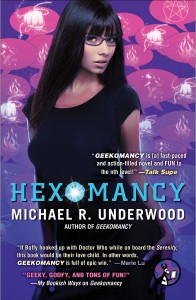
Mike’s latest novel is Hexomancy, the fourth Ree Reyes urban fantasy, where geek magic squares off against a quartet of Fate Witches hell-bent on revenge.
So now, I’m going to put on my digital media scholar hat once more and talk about some high-level stuff going on right now. Some pitfalls and pain points I see, as well as opportunities.
YouTube Red has been some time in the making. January of this year, musician Zoë Keating got a lot of shares and chatter with her post “What should I do about YouTube?” on this very topic. I see this move as part of an overall shift in the landscape toward more and more de-centralization of content, where 1st-party streaming systems and subscriptions replace once-agnostic content aggregation-esque systems like YouTube, Hulu, etc.
Here’s YouTube creator Hank Green discussing some of the ins and outs of this move.
I appreciate him spending the time to talk about the positives and negatives, avoiding a hard knee-jerk reaction. I’m worried about the independent creators who had found an equilibrium between Patreon, YouTube, and other venues who now have to pivot and adjust in a big way. It’s the way of life, but any logistical interruption costs creators money, because have to spend spend more of their time on admin and strategy rather than the actual creation.
And then, just hours later, I saw the news about the new Star Trek show, and that it was going to be almost exclusively available on CBS All Access, a paid streaming subscription which currently costs $5.99 a month.
It looks to me (and others, from what I’ve seen), that this is CBS positioning the new show as a Killer App for their streaming service, which I’d not heard of before today (I’m mostly out of the Media Criticism game day-to-day, thanks to having two other careers).
It’s potentially a very smart approach – and one that most of these proliferating paid services are following. HBO, Netflix, Hulu, Kindle Unlimited, all of them are bringing in or commissioning exclusive content to serve as Killer Apps for their individual services.
But here’s the thing about that proliferation – if every service has its own killer apps behind their pay walls, most consumers are very quickly going to max out on the $ they can or choose to pay for these services.
Consumer Side
An example – I have a steady, middle-class day job and I have a writing career. I’m married to someone who also has a steady job, and we have no kids. So we have more disposable income than a lot of US families. Between us, we pay for Netflix, Hulu, and High-speed internet. I get my razors on a subscription, I subscribe to a fiction serial (Bookburners), I’ve been an intermittent subscriber to Oyster and Scribd, as well as supporting a half-dozen creators on Patreon and intermittent subscriptions to broadcasters on Twitch.tv. As a household, we’re probably in the top quartile of subscription service users in the US. And I’m very much at the point of ‘Okay, that’s all I can do’ when it comes to subscription services. If I add one at this point, it probably involves dropping another.
And there are *so many* of them these days:
Twitch, YouTube, Netflix, Hulu, Crunchyroll, HBO Now, CBS Access, Spotify, Apple Music, Kindle Unlimited, Scribd, Amazon Prime, etc.
And that’s not even counting subscription boxes (L00tCrate, etc.) and subscription services outside of entertainment, like Harry’s, Blue Apron, StitchFix, etc.
Economic recovery in the US is happening, but it’s slow, and it’s accompanied by wage stagnation and income inequality (I can’t speak well to the economic situation elsewhere, so I won’t). So the % of people in the US that can afford numerous subscription services without seriously re-framing their budget is still not too large, from what I can tell. Whether this is part of an overall paradigm shift in how people budget and consume content is a different discussion (there are too many ways this could go – I have to focus).
Creator Side
Switching hats now – what does this look like on the creator side of the equation?
I see this proliferation of paid/gated services as a double-edged facet of the overall creative & commercial ecosystem. There are opportunities, but they’re potentially fraught.
Here’s what I see as the dominant progression for a creator trying to make money from their work (visual art, music, prose, comics, video, etc.)
Level 1 – Start small, give stuff away for free, sell some stuff. At Level 1, a creator is almost totally reliant on big systems, for both discovery and fulfillment/delivery. Basically no one knows who they are, so they join larger infrastructures and services to get the word out about their material through algorithmic and organic discovery.
Level 2 – Building Audience & Relationships — At this level, it becomes viable to sell some merch (T-shirts, mugs, stickers, patches, etc. Here, a creator can bring dedicated fans onto a growing mailing list. This level enables direct sales and stronger performance on retail sites, but the creator may still be largely dependent for discovery-enabled growth and a lot of fulfillment/delivery
Level 3 – Big Creators – Here, creators have a dedicated audience large enough they can get a living wage directly from their base, either totally direct or through Patreon/Kickstarter. Maybe they supplement their income speaking/appearance fees etc., being large enough that they are in demand not just as creators, but as entrepreneurs/thought leaders in their field. They may still use large systems, but if they do, they do so from a far stronger position – they are less dependent on any given system, since their base is strong, a base that is specific and mobilized, not platform-dependent.
This system is reductive, and by applying it broadly across media, I lose some nuance. Musicians can tour and get money from in-person appearances and sell merch there – novelists and poets largely cannot. Visual artists can sell commissions at conventions for solid income, writers have less opportunities in such situations. Etc.
Some take the pure indie path and are less reliant on the bigger systems, but then don’t have access to their discovery engine.
As the landscape moves toward more gated content, more push for exclusives as killer apps, more and more places to publish and publicize, creators have to have our eyes wide frakking open as we consider every new platform, every new distributor agreement, every new book deal, and so on.
Because things are moving fast, and these big platforms are only allies for as long as we’re useful to them. ACX changed its payout terms last February, and because ACX was the only real game in their town (self-publishing audiobook service), creators were forced to sign the new terms or walk from that service entirely. It’s the same type of choice YouTube creators have been forced into, though with notable differences (ACX was a flat-out rate cut, YouTube might come with additional payment, but requires more opt-in and cuts off other options). Any creator that relies on a single or small # of services/sites/retailers for a large % of their business is vulnerable to disruption, as Chuck says in the link re: ACX.
Anytime one of these big companies makes a shift, it causes huge ripples, and creators, especially those of us reliant on platforms for fulfillment, discovery, or other services/opportunities they offer have to roll with the changing tides.
In my opinion, creators right now have more to fear from Monopsonies and monopsonic behavior, than monopolies. Since so many creators are currently beholden to retailers and/or content services (writers and Amazon/B&N/Kobo/iTunes/Physical Bookstores, musicians and iTunes/Spotify/Pandora), if a creator wants to retail their work but doesn’t have enough reach/audience on their own, they use a seller/vendor. But if there are few enough vendors in their world, and those limited vendors exhibit monopsonic behavior, the result tends to be a major squeeze on the creators.
Paradoxically, the creators are the only reason the monopsonists can survive – if a majority of creators pulled out of monopsonic vendors, those vendors would collapse. But in the meantime, the lost income, the lost access could easily bankrupt a huge % of the creators pulling away from the monopsonist.
In a healthy market, there are a range of options, and creators can respond to a change of terms they dislike by removing their content from that platform. But for most video creators, removing everything from YouTube stands to present a loss of a huge % of their access and income, just as a prose writer would stand to lose a huge % of their access and income if they decided to not sell through Amazon.
Monopsonic behavior also impacts larger creator groups, like publishers – if one retailer or wholesaler gets too strong, it can create problems. It’s the WalMart problem. Wal-Mart pushes down prices, then makes up their $ in volume and by demanding better terms from their vendors, The vendors (publishers, manufacturers, etc.) then get to choose – pull out of the single-largest physical retailer, or accept the terms. Because individually, Wal-Mart doesn’t need most vendors. They need a plurality or majority, but as long as the selection adds up, individual vendors can come and go.
So when you’re one of those vendors, one of those creators, you end up in a really terrible situation. And that worries me. I want a healthy marketplace, where creators (authors, musicians, etc.) and the publishers/labels/etc that work with them have options, have recourse for if/when terms change in a way that becomes untenable.
The sky is not falling. But I will continue to point out rain clouds when I see them forming. Because then the smart folks can put out buckets and save on the water bill, or pull the lawn furniture inside before the storm breaks.
I’ll stop there before torturing the metaphor any further.
What do you all think about these streaming service moves – YouTube Red, and Star Trek on CBS All Access?
—
Mike’s latest book is Hexomancy, the fourth Ree Reyes urban fantasy. Geek magic squares off against a quartet of fate witches hell-bent on revenge.
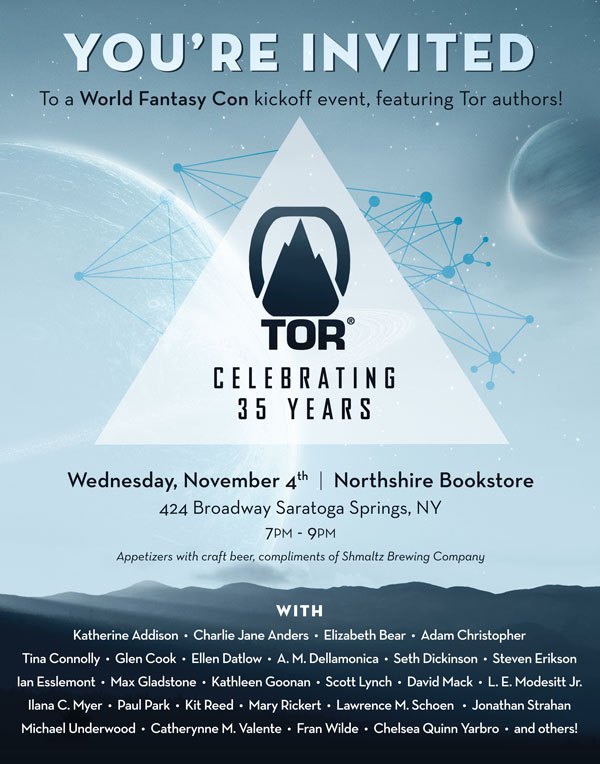
I’m headed up to Saratoga Springs next week for the World Fantasy Convention, and if you’ll be there on Wednesday, I’d love to invite you to come to Northshire Books, where Tor Books/Tor.com Publishing is hosting an event. I’ll be there (possibly even with copies of The Shootout Solution!), along with many other fabulous authors.
Over lunch, I tweeted out a handful of short comics reviews from recent books I’ve read. Here’s a Storify of those reviews, and some links below to help find the books:
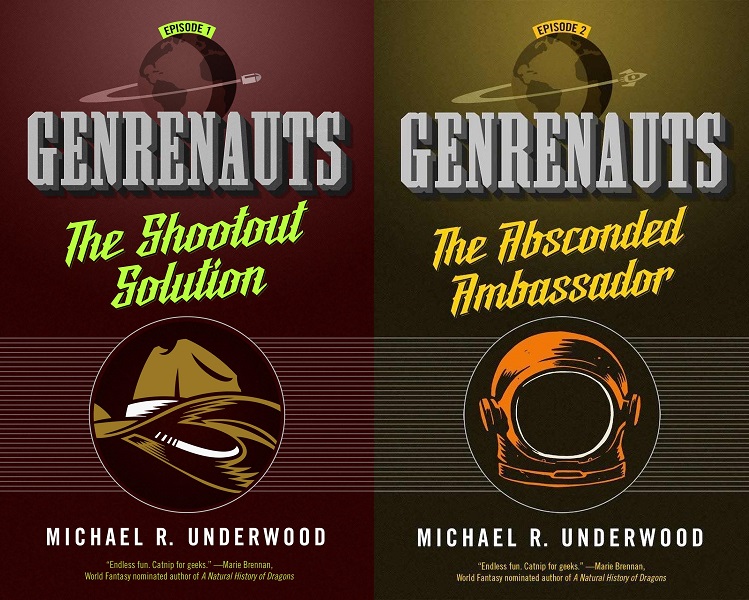
Tor.com has revealed the covers for February 2016 Tor.com Publishing titles, including The Absconded Ambassador (Genrenauts Episode 2), as well as books by Mary Robinette Kowal and Tim Lebbon.
When Irene Gallo at Tor.com asked for some notes on what I’d like to see for covers for the Genrenauts series, I had one primary goal, and some suggestions of how to achieve it.
More than anything, I wanted a strong series style for the covers. By that I mean that if you put the covers next to one another on a screen, or the covers showed up in ebook retailers together, they’d be unmistakably, instantaneously recognizable as being in the same series. I wanted each cover to give some of the character of the individual story, as well, rather than just using an identical cover and only changing the lettering or something. What Peter Lutjen has done threads the needle brilliantly – each episode has individual touches, but the series style is incredibly strong, which is both visually delightful and should be very useful, especially in online retailers, where the books clearly belong together even when viewed as thumbnails.
In each cover, the central image in the circle at the bottom of the image represents the genre being represented by presenting the ‘hat’ that the Genrenauts wear in that region – a Stetson for The Shootout Solution, a Western, and then a classic astronaut’s hat for The Absconded Ambassador, a Science Fiction in the Babylon 5/Deep Space 9 mold.
One of the ways I suggested that we might achieve strong series styling was to have a consistent design element – the Genrenauts Logo. Irene and Peter took that idea and delivered in a way I didn’t expect but absolutely love – the series shows off a classic Radio Serial-style planet, accentuated by the GENRENAUTS lettering.
I also love the little accents. The bar at the top indicates each book’s episode # (again referencing the TV format which has been present every step of the way for me). And the planet has a different object orbiting in each episode, further signaling the genre – a bullet for Western and a rocket ship for Science Fiction.
The combination of typography and design conveys the sense of playing with familiar structures, of looking back and referencing different media and how they shaped storytelling, which applies perfectly to Genrenauts. Where the Ree Reyes series focused on geekdom in specific, Genrenauts examines storytelling more broadly.
I couldn’t be happier with these covers, and am incredibly excited to get them, and the books they represent, into your hands.
The fine folks at Tor.com are hosting a giveaway for three signed galleys of The Shootout Solution – Genrenauts Episode 1. If you win, you’ll get the book most of a month early!
I’m very pleased to share the news that Macmillan Entertainment is going to be representing Genrenauts for TV/Film rights. This is not an option sale – it’s the equivalent of when I partnered with Jon Cassir at CAA a couple of years back for him to represent Geekomancy for media rights. This means that Macmillan Entertainment is sending the book out to producers, production companies, etc. and serving as my advocate in offers for film/TV rights.
I had a good chat with Brendan Deneen, the head at Macmillan Entertainment when we were talking about a partnership, and he totally gets Genrenauts and what makes it tick, including a lot of my biggest influences. I’m very excited to see what comes next.
And as a reminder, you can pre-order Genrenauts: The Shootout Solution right now in trade paperback, ebook, and audiobook. November 17th is getting very close now. I can’t wait to introduce you all to Leah, King, and the whole Genrenauts team.
If you’re heading to NYCC this week, here’s where you can find me doing official-type things! I’ll also be walking the show floor, attending panels, and scouring artists’ alley all weekend. Ping me on Twitter if you want to meet up!
Thursday, Oct 8th
Signing!
2pm – Booth #1828
In-booth signing with fellow Pocket author Kristi Charish. S&S is providing rare bound galley copies of GEEKOMANCY which we’ll have for me to sign and send home with readers.
Saturday, Oct 10th
Books to Movies Wishlist
4pm – Room A101
The Martian. Foundation. American Gods. Redshirts: So many iconic SFF novels are finally scheduled to hit the big screen, thanks to the rabid fandom of recent dramatizations of Game of Thrones, Outlander, The Hunger Games, Divergent. But what’s on the big screen wish list of this Panel of bestselling speculative fiction superstars? They all agree that the obvious franchises have been done already – and now, they want to discuss with NYCC Attendees what lesser-know/cult fave titles should invade theaters and march into cable programming! Join us for a nerdy-fun discussion about which science fiction and fantasy must-reads would really make celluloid magic!
Panel:
Charlie Jane Anders
Christopher Golden
Chuck Wendig
Jennifer Armentrout
Clay Griffith
Susan Griffith
Michael R. Underwood (Moderator)
Post-Panel Signing
5:15pm-6:15pm WORD Bookstore 1-B
Come and get books signed by the panelists, and me! We’ll have a very small # of the left-over Geekomancy galleys for people at this signing.