Why Writing Diversely Matters To Me

The Younger Gods is my fourth published novel, but my first with a white male protagonist. This is not a co-incidence – it was a very deliberate choice.

Stories make our world. As a writer, I help tell the stories that people internalize to set their expectations of what the world is, and who is welcome and valid in it. For me, being a writer means including people from diverse backgrounds and lived experiences. To do any less is to erase them from history and deny their existence.

Instead, I aggressively seek out ways to write characters from diverse backgrounds and lived experiences, both to show the breadth of viable lives and perspectives that humanity holds, and to use my disproportionately-favored voice as one with privilege Yatzee (male, straight, white, cisgender, middle class, neurotypical, able, etc.) to bring greater attention to and respect for the diversity of lived experiences in the world.

Writing diversely has been a mission that I embrace whole-heatedly, challenging myself to learn more about the world and about the people in it. I feel that writing diversely greatly enriches my work, helps me avoid cliche and lazy storytelling. In writing diversely, I seek to create stories that people from many different lived experiences can see themselves in, stories that say, “We can all be heroes.”

So, that’s all great in theory, Mike. But do you walk the walk?

In addition to actively casting The Younger Gods in a manner that fits the city’s demographics (numerous African-american characters, Filipino characters, Hispanic characters, South Asian Characters, etc.), I made several conscious casting changes in The Younger Gods – one in the middle of the rough draft, and another change very close to publication. the first change is that the character of Dorothea was originally a man. I wanted my cast to have a better gender balance, and found that writing the Broadway Knight character as a woman was even more interesting for me.

The other changes were the opposite direction, changing a female character to male. In an earlier draft, Jacob’s friend Thomas was his girlfriend, Jennifer – things still went sour after prom, but it was a loss of a romantic partner instead of a platonic friend. The death of Jessica had been part of the character’s story pretty much since the beginning, from when I first had the idea over ten years ago.

But in the process of revisions, I realized that there was no way to keep Jessica in the role without her being an example of Women in Refrigerators (trigger warning: sexualized violence against women). I’d internalized that narrative trend thanks to decades of reading comics and playing video games, etc., and only when I was nose-deep in revisions did I realize that I was replicating it without useful critique or subversion. No matter how I framed the death or demonized it, it was still another Fridging. And I wouldn’t have been proud of the work if I hadn’t made that change. In the conversation I had with my fiance, I had to actively push back the panic and shame I was experiencing about putting a book out with a major fail like that. But thankfully, I was able to make the change, with the support of my editor, Adam Wilson.

The Takeaway

Making that change not only meant that I didn’t have a fridged girlfriend as a motivating factor for my leading character, but what I ended up with was a stronger story overall. Having Thomas in that role – as Jake’s one friend betrayed by his family, sending our hero away from the family – meant that all of the other themes of friendship and alienation throughout the book were enriched by that loss and guilt about Thomas that Jacob felt.

In my experience as a consumer and student of stories, the loss male best friend is a far less common motivating factor for a male character than the loss of a romantic partner. Male friendships are downplayed, contextualized as being ‘bromances,’ often to avoid homosocial/homosexual connotations (because the patriarchy says that gay = effeminate, and since feminine = bad, gay = bad! Thanks, patriarchy! Your logic is as straightforward as it is spurious and toxic). So having Thomas be a major motivator for Jake gave me a new perspective on the story. And I think the novel is stronger for it, since so much of the rest of the novel is about Jacob learning about how to reach out to other people, to build friendships and rely on those friends and allies.

It is not sufficient for me to write only people who look like me, who come from my exact background. Writing diversely gives me challenges, forces me to stretch my writing skills, and creates the opportunity for me to explore the world through the perspective of people who come from and have lived very different lives than I have. I can’t tell other writers that they *have* to write diversely. Even if I did, it’s better for writers to come to that decision for themselves. I think it’s far better to write diversely and to mess up than to be afraid and let that fear of rebuke control you, so that you settle for the easy writing choices and produce another white-washed, overwhelmingly male, white, cisgenger, straight world that Hollywood so often shows us as their ‘default).

Writing Diversity While Playing in Life’s Easy Mode

The weird thing is that my Privilege Yahtzee actually puts me at an advantage even when intentionally writing diversely. I’m more likely to be able to sell a work that has a lot of diversity, than a woman or a person of color is. And once sold, I’m more likely to be lauded for it, as a “brave” or “insightful” or something. All of this, just for meeting a minimum bar of decency that I set for myself. It’s a weird reality, but it seems to be the way of things. And if I can use my privilege to get more stories into the world that acknowledge and celebrate the lived experiences of people from diverse backgrounds, then I will totally do so. And along the way, I’ll also use my privilege to promote the voices and works of people from diverse backgrounds and lived experiences. I can do both, and both make the world better.

Writing diversely, and doing it well, is not easy. I will mess up. I have already messed up, and been called on it, and have taken those comments to heart. But I wouldn’t have learned those lessons, wouldn’t have become better-able to write diversely, if I hadn’t tried.

This is not about fishing for cookies, it is not about white/male/anything guilt.

Here’s what it is:

  • A promise to myself that I won’t settle for my ingrained, lazy defaults as a person who grew up in a culture that’s patriarchal, kyriarchal, racist, and more.
  • A realization that challenging my own assumptions will let me dig deeper and find fresh, more interesting ways of storytelling.
  • A public pledge to tell stories about and for as much of the world as I can, to make sure that I do not erase and ignore people who have been marginalized, oppressed, and erased in/from narratives of all sorts (fictional, historical, etc.).
  • An effort to show other writers who are intimidated by the idea or practice of writing diversely for fear of its difficulty or fear of getting it wrong.

To those writers, let me say this: it’s better, in my eyes, to be a screw-up with good intentions, working (imperfectly) on the side of social justice and inclusion than to take the easy route and let your work perpetuate the crappy, marginalizing and erasure-tastic status quo. Your mileage may vary, but this is where I stand.

When it comes to writing diversely, I am proud of The Younger Gods. I put a lot of time into making sure that it showed a more accurate cross-section of the people who live in actual New York even as I was moving apocalyptic sorcerers, Nephilim, and other super-humans around to chase each other and have fight scenes. I feel that it is a stronger book for being diverse, and I hope you will enjoy it.
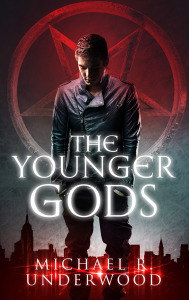
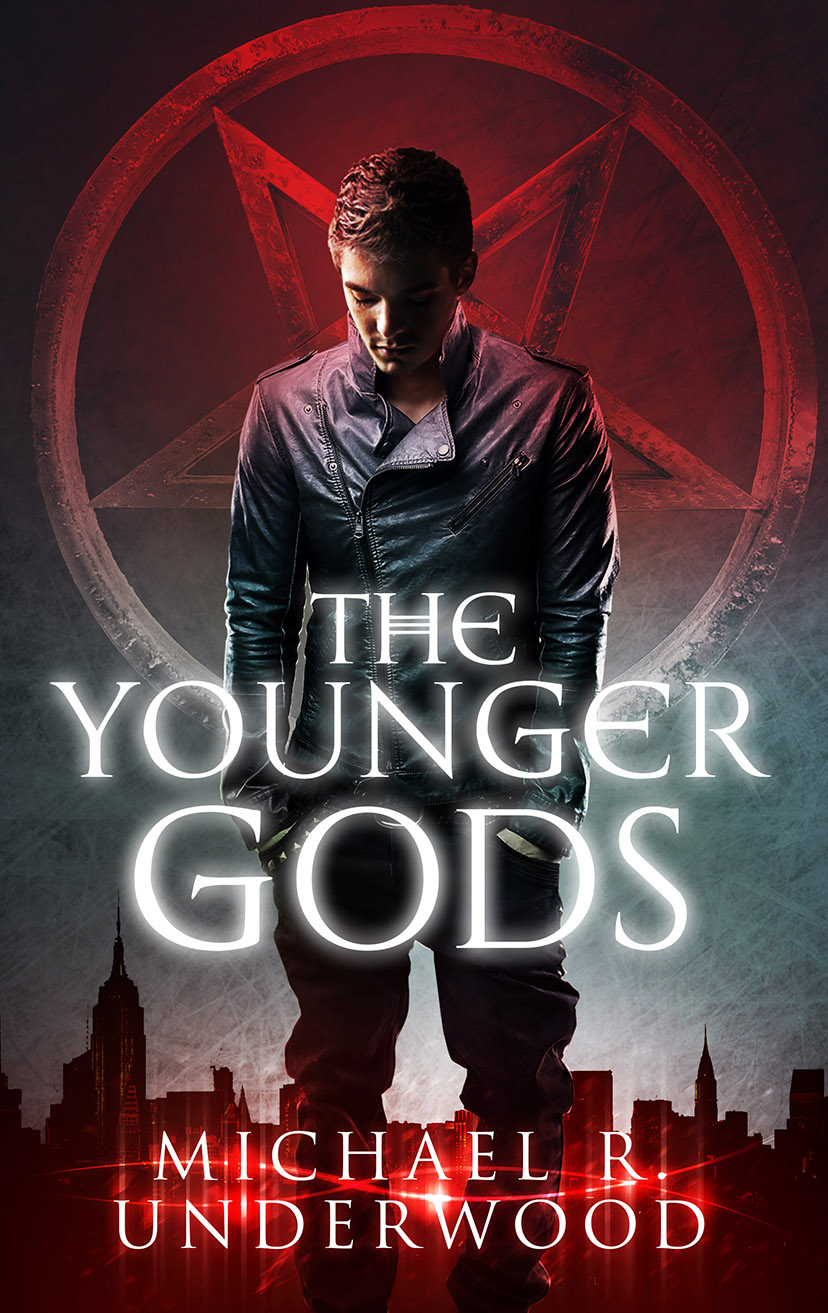
 

The Younger Gods cover

Simon & Schuster’s New Deal with Amazon

So, this news broke yesterday: http://time.com/3525993/amazon-simon-schuster-hachette/

With precious few details.

Context: My books Geekomancy, Celebromancy, Attack the Geek, and The Younger Gods are all published by Simon & Schuster. I’ve got a lot of literary skin in this game. I also have work out with Amazon Publishing, who published Shield and Crocus, and are contracted to publish an original graphic novel in that world.

As a S&S author, I received a note last night from S&S CEO Carolyn Reidy, indicating that the deal was advantageous to S&S and authors, maintaining author’s share of sales.

So the big question is: What is the new deal? Agency pricing for ebooks has typically been a 70/30 split, with publishers taking 70% of list, and the retailer taking 30%, which they can discount out of (sometimes, depending on the deal).

If this means that S&S ebooks are moving from Agency Lite to a new Agency, then individual author share is not likely to change, consistent with current reports. But this is likely to be a different kind of Agency deal, and there may be small print aspects to the deal that change the math.

I’m hoping that more details will come out, especially as a S&S author:

In the meantime, I have far more questions than answers:

What’s the publisher/retailer split?

What are the ‘limited exceptions’ where Amazon will be able to set the price of some books?

And what went differently in the S&S negotiations than those with Hachette? It’s unlikely that the exact details will be made publicly available, but if various Big Five publishers end up with notably different terms with Amazon, it behooves authors to know at least some of the details about those differences as we make our decisions about where to submit and publish our books.

UPDATED 1:01 PM with more details.


Joys of Recent Reading (Comics)

As part of my move into comics writing, I’ve been reading tons of comics, largely assisted by a giant haul from NYCC.

Here’s a few comics I’ve read recently and enjoyed.

  • Birthright #1 (Joshua Williamson, Andrei Bressan) – Disappeared child story meets epic fantasy quest…with several twists.
  • Moon Knight Vol. 1 (Warren Ellis, Declan Shalvey and Jordie Bellaire) – Batman-esque one-shots starring an Ellis-ified version of the classic Marvel hero.
  • Artful Daggers (Adam P. Knave, Sean E. Williams, Andrew Losq) – Set 50 years after the events of A Conneticut Yankee in King Arthur’s Court – Anti-authoritarian action espionage.
  • Edge of Spider-Verse #2: Gwen Stacey Spider-Woman (Jason Latour, Robbi Rodriguez) – THE COOLEST ONE-SHOT where Gwen Stacey gets spider-powers instead of Peter Parker. I am WAY excited about this getting an ongoing comic.
  • Skullkickers Treasure Trove Vol. 1 (Jim Zub, Paul Stevens, Edwin Huang, Misty Coats) – Teenage D&D Sword & Sorcery adventures that starts over-the-top and then keeps going. With bonus shout-outs to Fafhrd and the Grey Mouser in the back matter.

The Younger Gods PROMONADO round-up

It’s PROMONADO time once again, this time for THE YOUNGER GODS, my new supernatural thriller.

The Younger Gods cover

First, some juicy reviews:

“Underwood has definitely spun himself a web of complex and intriguing characters and plot, and I can honestly say I look forward to reading whatever else he puts out.” – Beans Book Reviews

The Younger Gods features a strong narrative voice, right from the start. From there, the plot moves at a ridiculous pace, in very intentional sort of way.” – Ristea’s Reads

“There’s so much that goes into Jacob as a character, all of these layers and effects and influences are clear in his character making him very real, very complex and very interesting to follow.” – Fangs for the Fantasy

“…a fun and fast paced read that I would recommend to any fan of the paranormal genre that is looking for something a little different.” –Avid Reviews

“During the best moments, the complex supernatural network is reminiscent of what I loved about Neil Gaimen’s Neverwhere; we’re treated to what feels like the tip of the iceberg of a vast and complex world.” – Throw This Book At Me

“The Younger Gods is a solid urban fantasy with an interesting premise and characters you can’t help but get invested in.” – Bibiotropic


On Monday night, I was a guest on the MythWits, talking about all three of my series, plus a game!

I did a Q&A at Fallen Angel Reviews.

Over at the Qwillery, I talk about writing a character with huge blind spots.

And at Mary Robinette Kowal’s journal, I share My Favorite Bit of THE YOUNGER GODS.


NYCC After-action Part One

I have survived yet another New York Comic Con. The biggest ever, by current reporting.

This year, I had an extra mission, a driving interest behind my presence, thanks to my decision to get into comics writing.

Most years, I graze the fields of NYCC, drinking in the geekdom and following the tides of my interests.

This year, I spent a *lot* more time in Artists’ Alley, talking with creators, making acquaintances and friends. If I’m going to work in the comics community, I need to be a *part* of the comics community, and in a much greater way than I have been happily reading on my own and talking with people about it intermittently.

Which means that I came back from the con with my suitcase *completely full* of comics. And a few clothes, I guess. Mostly comics.

I had several really cool conversations with creators, and got to hang out a lot more with some folks I’d met at cons earlier in the year. It’s an odd thing to be operating in a new professional world, where I don’t recognize people by sight like I do in SF/F prose.

Here’s a quick round-up of some of the swag I acquired during my trip. It…was a lot. My bank account took a not-insubstantial hit thanks to my love of Cool Stuff.

  • The Dare Detectives “The Snow-Pea Plot” (Ben Caldwell)
  • Monomyth #1 (Siike Donnelly, Eric Ninaltowski)
  • “Comics” a collection of work by students in the SVA Illustration Department and Cartooning Department.
  • Shadowman Vol. 1-5
  • Skull Kickers “Treasure Trove Vol. 1” (Jim Zub, Edwin Huang, Chris Stevens)
  • Sleepy Hollow #1 (Marguerite Bennett, Jorge Coelho, Noelle Stevenson)
  • Artful Daggers “Fifty Years Later” (Adam P. Knave, Sean E. Williams, Andrew Losq)

And…more where that came from. I may have gone a little overboard. I also bought some art, which I will show off in a separate post.

THE YOUNGER GODS is here!

The Younger Gods cover

That’s right, my third (and final) major release for 2014, the first-in-series Supernatural Thriller THE YOUNGER GODS is here, complete with awkward sorcerers, bizzare monsters, and The Big Apple.

Here’s what people are saying:

“it’s a marvelous start to a new series – heavy on the action that opens up a new world of mythology to enjoy.” – Pop.Edit.Lit

“Underwood has definitely spun himself a web of complex and intriguing characters and plot, and I can honestly say I look forward to reading whatever else he puts out.” – Beans Book Reviews

The Younger Gods features a strong narrative voice, right from the start. From there, the plot moves at a ridiculous pace, in very intentional sort of way.” – Ristea’s Reads

“There’s so much that goes into Jacob as a character, all of these layers and effects and influences are clear in his character making him very real, very complex and very interesting to follow.” – Fangs for the Fantasy

“…a fun and fast paced read that I would recommend to any fan of the paranormal genre that is looking for something a little different.” -Avid Reviews

Baltimore Book Festival

Baltimore Book Festival

This weekend is the Baltimore Book Festival! Normally held in the Historic Mt. Vernon district, this year the festival is happening in Baltimore’s Inner Harbor, which should lead to even more foot traffic, assuming the weather holds.

I’ll be participating in events over the weekend, mostly at the SFWA tent. Here’s my schedule!

Saturday, September 27th

12PM-2PM — Dangerous Voices Variety Hour with Marissa Meyer and Charles Gannon

The Dangerous Voices Variety Hour takes its cues from NPR’s “Wait, Wait Don’T Tell Me” quiz show and Orson Welles’ original War of the Worlds broadcast. It features readings, trivia, great prizes, irreverent author interviews, and more fun than you thought you could have at a reading.”

Participants: Marissa Meyer and Charles Gannon. Co-hosted by Sarah Pinsker and Michael Underwood.

4PM-5PM — How can I get my writing noticed? A Must-Do Panel for Writers in the Modern Age

You’ve finished a story or book and now you’d like to get it published and start buzz about your work. But in this modern age, the avenues for publication and promotion are dizzying, and they often tangle together. What are your options? What will bring you the most word of mouth? The most reviews? The best pay? Should you go it alone or seek a major publisher? Come talk with publishers, editors, con organizers, and reviewers about your options.

Panelists: Scott Edelman, Elektra Hammond, Don Sakers, Peggy Rae Sapienza, Mike Underwood, Jean Marie Ward

Sunday September 28th

12 PM — Jeff VanderMeer — The Southern Reach Trilogy

I’ll be introducing Jeff VanderMeer as he speaks on the Ivy Bookshop stage.

Amazon Crowd-Sourced Publishing

According to multiple sources, Amazon is preparing to launch a crowd-sourced, almost reality-TV-style publishing program, where authors upload unpublished MSS and those that receive the most votes get considered for Amazon Publication (by the genre/category-specific imprints, or by a new imprint, I wonder?) with fairly generous terms.

Sources:

http://www.thebookseller.com/news/amazon-launch-crowd-sourced-publishing.html?utm_content=bufferc00c0&utm_medium=social&utm_source=twitter.com&utm_campaign=buffer

http://www.publishersweekly.com/pw/by-topic/digital/content-and-e-books/article/64103-amazon-launching-new-crowdsourcing-publishing-program.html

https://kdp.amazon.com/community/thread.jspa?threadID=207604&start=0&tstart=0

Thoughts? We’re in early days yet, but this looks to me like a feeder program for Amazon Publishing.

EDIT: You can sign up for updates re: this program here.

From Page to Panel, Part One

A couple of weeks back, I attended my first Baltimore Comic-Con. It clocked in at around 15,000 people, and unlike the bigger Comic-Cons (NYCC or PHXCC) that I’ve attended, Baltimore was still very much focused on comics.

After two days of panels, browsing, meeting creators, and loading my bags down with glorious comics goodness, I should have expected this to happen.

Sometime during the weekend, I was bitten by a radioactive comics bug. It re-awakened my often-deferred interest in writing for the form.

I grew up reading comics, taking the change from our recycling deposits down to the friendly local comic shop in Brooklyn to buy the latest issue of Spider-Man, Batman, or X-Men. I’ve tried my hand at writing comics scripts only a little bit, but often thought about what it’d take to move into that form.

Now, let me be clear that I have no intentions of leaving prose writing. That’s my home base, and I’m not likely to ever stop writing prose. But more and more, I see writers crossing formats, including several of my writing idols (Neil Gaiman, China Mieville, Greg Rucka, among others).

Therefore, the last couple of weeks, I’ve been devouring comics, deepening my immersion in the form, investigating what’s going on at the top of the form with the works that are making waves and pushing at the edges of what the form can and is doing.

Here’s a representative sample of my research list:

  • Saga (Brian K. Vaughn and Fiona Staples)
  • The Wicked + the Divine (Kieron Gillen and Jamie McKelvie)
  • Batwoman (JH Williams III and W. Haden Blackman)
  • Lumberjanes (Grace Ellis, Noelle Stevenson, and Brooke Allen)
  • Gotham Central (Ed Brubaker, Greg Rucka, and Michael Lark)
  • Rat Queens (Kurtis J. Wiebe and Roc Upchurch)
  • Ms. Marvel (G. Willow Wilson and Adrian Alphona
  • Velvet (Ed Brubaker and Steve Epting)
  • Lazarus (Greg Rucka and Michael Lark)
  • Global Frequency (Warren Ellis and various artists)
  • Chew (John Layman and Rob Guillory)
  • Atomic Robo (Brian Clevinger and Scott Wegener)

I’ve also been diving into some craft books, and revisiting some others I’ve already read:

  • Words for Pictures – Brian Michael Bendis
  • Writing for Comics and Graphic Novels – Peter David
  • Understanding Comics – Scott McCloud
  • Making Comics – Scott McCloud
  • Save the Cat – Blake Snyder

Lessons learned so far

Transcribe

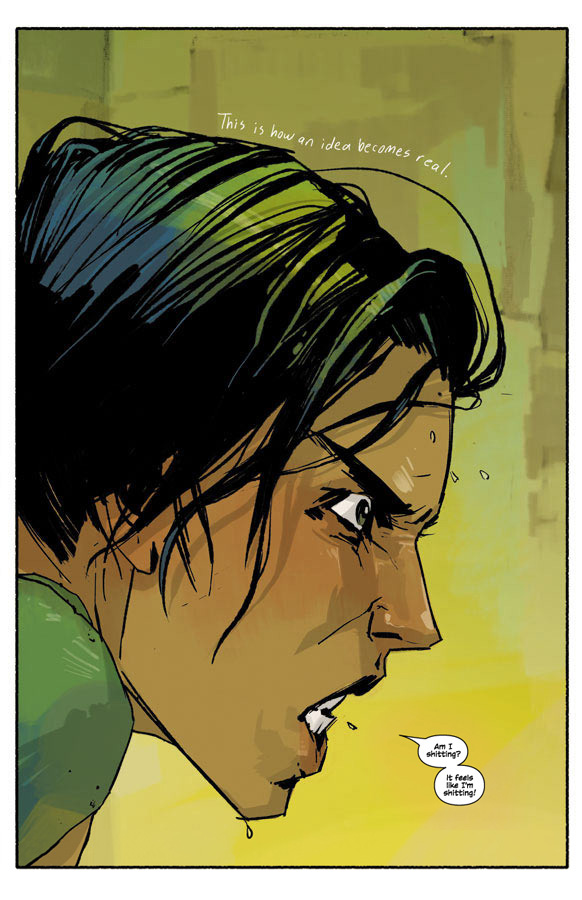
One of the best things I did in trying to deepen my understanding of the differences between writing prose and writing for comics was to open my copy of Saga Vol. 1 and transcribe the finished comic back into a script, trying to capture the visuals, emotion, and to see how much text fit on the page.

Saga, Issue #1 page 1. From Image Comics. (C) Brian K. Vaughn and Fiona Staples


Script != Finished Page != Script

The biggest challenge I’ve faced so far coming to comics writing is that the finished product is drastically different from the working document that a comics writer will produce. When learning prose writing, you can look at a piece of fiction and see the final draft as the actual product. But in comics, there’s so much of a collaboration and melding of the styles and skills of several creators (sometimes as many as six: writer, penciler, inker, colorist, letterer, editor, graphic designer) that a writer’s script is only one part of the equation. For me, that makes it harder to tease out where my part is, especially writing without having yet found any collaborators. I want to write some scripts and see how well my novelist chops translate before trying to make finished comics, and then start reaching out when I’m confident that I’ve learned the comics form well enough to start making professional works.

Basically, It’s Writer Multi-Classing

I’ve written seven novels (two of which are trunked, never to be seen again), and a long novella, as well as a couple dozen short stories. In D&D terms, I’m somewhere in the 3-5th level in terms of my Prose Writer class. But this, this is taking a new class – Comics Writer. There are different skills, different class abilities, and a whole power tree of collaboration powers for when you’re in a party with other comics creators. So while my overall Writer level combines my Prose Writer and Comics Writer levels (like a Wizard taking a level of a prestige class), my Comics Writer level is still 1 right now, so there’s a weird feeling of starting over, of going back to square one. I know a lot about storytelling, but the format, the medium is very different, and I’m having to learn to adjust to it, just like I adjusted from storytelling in RPGs to storytelling in prose.

Choosing Your Moment

Since the comics form is one where moments (panels) are compressed into a fluid narrative experience by the reader, one of the most important tasks for a creator is to chose your moments, to pick which snapshot in the action to depict in a panel, as well as how to space out your moments – several panels showing moments very close together, or jumping farther in time between panels. This is not unlike the task of scene selection in prose writing, or picking where to dramatize within a scene, but it’s very much its own thing in comics.

The Business End

I work in SF/F prose publishing. I’ve been learning about the trade publishing industry, and SF/F prose publishing in specific, for around a decade. It has certain processes, customs, and paths to publication.

Comics, unsurprisingly, is different. I’ve asked questions about submission and breaking in to creators and publisher staffers at the various comic-cons I’ve attended, and I’ve received incredibly divergent answers.

Here’s how to break in, as I’ve been told:

  • Self-publish your own works and the editors will find you.
  • Send everything you make to the editors you want to work with.
  • Pay an artist to do a whole graphic novel and then try to sell it to publishers.
  • Pitch editors with ideas and then they’ll ask for scripts. Then they’ll find you an artist.
  • Submit a complete 8-page comic.
  • Submit a full 22-page comic.
  • Self-publish for a while and then try to pitch a new project to publishers.
  • Look for comics anthology invites and start there.

As you might be able to tell, that’s a fair range. The fact that I have several novels out from traditional publishers changes the game for me somewhat, but it doesn’t give me one clear path to publication. In prose publishing, you can query agents, who then pitch to editors. There are other paths as well, but this is the ‘standard’ path. Comics doesn’t seem to have as clear a ‘standard’ path to publication. (Note that the standard path in prose publishing is often anything but easy. But it is the default, one that takes an unpublished debut work and then gets it sold to a publisher).

As you’ll note, this post says ‘Part One.’ I’ll keep talking about my experiences moving into comics writing, both to remember what the process was like, and to (hopefully) cast some light on the journey for other writers interested in moving into comics, either from a prose background or not.