GenCon Schedule

When I was a teenaged gamer, GenCon was The Con. It was just an hour’s drive away, and I’d go every summer. I’d save up my money, then when I was working at a game store, I’d always sign up to work the booth at the con, or arrange with local game designers to demo their RPGs at the con. I’d go, I’d game, I’d work, and I would soak in the glory of the gaming industry’s biggest con.

And since then, GenCon has only gotten bigger. Now it sports an incredibly robust Writers Symposium, with craft and business-oriented programming throughout the weekend.

My primary activity for the weekend will be running the Angry Robot Booth in Author’s Alley – Table Z. You can also find me on the following panels in the Writers Symposium:

Thursday

9am – Writer’s Craft 101 – Room 245 (SEM1577055)
5-7pm – Once & Future Podcast MEGACAST (SEM1578894)
7pm – Writer’s Craft – Novel Outlines & Synopses – Room 244 (SEM1577118)

Friday

6pm – Worldbuilding: Mythology – Room 244 (SEM1577134)

Saturday

3pm – Worldbuilding: Creating Languages – Room 244 (SEM1577142)
4pm – Worldbuilding: Creating Religions – Room 244 (SEM1577143)


See you there!

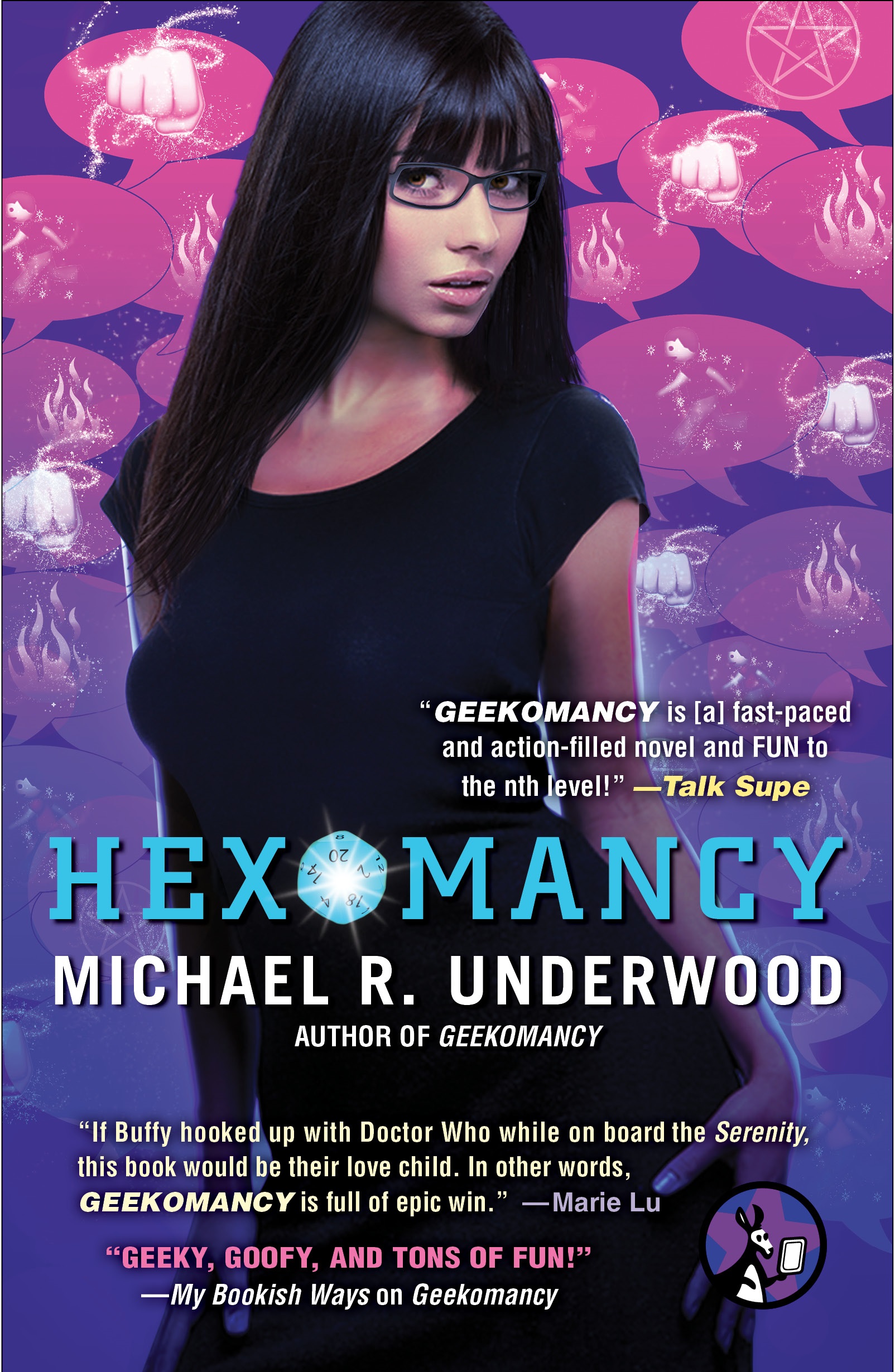
HEXOMANCY on NetGalley

Hello, all!

For the reviewers among you, I’m very excited to share the news that HEXOMANCY is now live on NetGalley, ready for your requests and reading.

Hexomancy cover

I’m very proud of this novel, as it brings together a lot of threads from the three previous Ree Reyes stories, and is the conclusion of the first major arc for the series.

Go forth and happy reading!

CONvergence schedule

Hello, all! I’m headed out to the Twin Cities this week for CONvergence, a large fan-run con that’s been running for more than 15 years. I first attended two years ago as part of an Angry Robot expedition with Lee Harris and Emma Newman, and was completely bowled over by how fun and well-run the convention is.

This year, I’m on four panels and an off-site event. Here’s where to find me!

July 2nd

2pm The Smurfette Principle in Marketing (DoubleTree Atrium 6)

3:30 pm Ebooks and the Marketplace (DoubleTree Atrium 7)

July 3rd

11:00 am Storytelling in Comics and TV (DoubleTree Plaza 3)

July 4th

11:00 am The Skiffy and Fanty Show Live: Space Travel and Its Discontents (Crowne Plaza A-E-I-O)

8-9 pm:  “The Skiffy and Fanty Hangout” in the Doubletree Bar Area! — come play games (Sabacc, Koi Koi, and more!), hang with various members of the crew, and have a drink!

And – on Thursday, July 2nd, I’ll be at Source Comics & Games with several other writers for ‘Gaming with Authors’ – as fine an event idea as I’ve ever seen.


I also have a few other ideas up my sleeve, so keep an eye on Twitter.

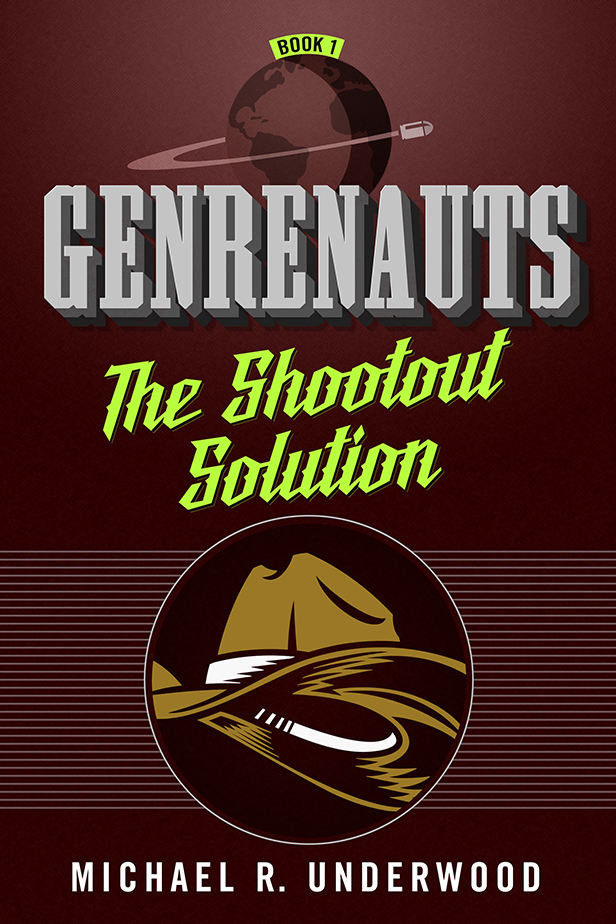
GENRENAUTS cover reveal!

The fine folks at io9.com have exclusive cover reveals for four of the Tor.com novellas, including my own Genrenauts Episode 1: The Shootout Solution. Go forth and bask in the artistic marvel!

Big props to Peter Lutjen for a stunning design job on my cover – I love every single piece of it. And a reminder that you can pre-order the book on Amazon, Barnes & Noble, Kobo, and iTunes before it drops on November 17th.

cover of The Shootout Solution, art by Peter Lutjen

GEEKOMANCY Daily Deal!

Geekomancy Cover

Hello, all – I’m excited to share the news that GEEKOMANCY has been selected as a Kindle Daily Deal today, on sale for just $1.99. This is a great chance to pick up a copy of the book, or to buy a copy for a friend (Amazon has an easy ebook gifting system).

You can find the book on sale here to get a copy for yourself for a friend.

Additionally, I’d love your assistance in spreading the word about the deal – on Twitter, Facebook, Reddit, Google+, etc. Please find below a Tweet-sized message for ease of use:

What it fandom was a magic system? GEEKOMANCY by Michael R. Underwood, a Kindle Daily Deal for just $1.99! http://www.amazon.com/Geekomancy-Ree-Reyes-Book-1-ebook/dp/B007SNRRP8/ref=sr_1_1?ie=UTF8&qid=1432474904&sr=8-1&keywords=geekomancy


With your help, we’re hoping to get the word out about GEEKOMANCY to lots of new readers who can then enjoy the series as we lead up to the release of HEXOMANCY in September.

Geek on!

The Many Sides of Bundling

Earlier this week, Tor announced that it had partnered with BitLit to offer discounted ebook editions to readers who already own print editions ($2.99 per book).

Books

Angry Robot has had a bundling promotion running for some time, offering free ebooks to customers who buy the physical from one of several bookstore partners, or at conventions.

Bundling has been an on-again, off-again hot-button topic in the publishing world, as readers lobby for getting the ebook edition for free with their physical purchase. A frequent argument I see is that if a reader pays for a book, they feel like they should be able to consume that book in whatever format they want – they’ve bought the content, so format shouldn’t matter.

The production realities in publishing aren’t quite that simple. The final steps in book production diverge between print and ebook – so the  work-hours that make an ebook are different work-hours, with different skills and programs needed, than the work-hours that produce a finished physical book.


Don’t get me wrong – I think print + ebook bundling should be universally available. TV and Film companies have already figured this out – in the US at least, consumers can by a DVD, DVD + BluRay, or DVD + BluRay + Digital Download. Sometimes there’s even a 3D BluRay in there. But the different formats are available together. And sometimes the programs involved in the digital download even work (and sometimes they don’t – I’m looking at you Ultraviolet).

To sell a bundled print + ebook edition, here’s what publishers have to do:

1) Partner with BitLit or similar companies, selling companion ebooks at a discounted price to verified print owners (who mark up their physical book to claim the ebook).

2) Create a separate edition (with a separate ISBN) for bundling. That bundling edition would likely cost $1-$5 more than the normal physical edition, just as the DVD + BluRay + Digital Download edition of a film/TV show costs ~$5 more than the DVD + BluRay edition (though digital films/TV shows tend to cost more than individual ebooks). This probably means creating a series of download codes for every book, printing a pull-off-sticker on the inside cover or the like. Printing download codes in plain sight in or on the cover would be incredibly rife for abuse, so some precautions are expected. Marvel comics does this as the default for some comics, offering a free digital download.

2a) As above, but offer universal bundling for no additional cost. That has its own difficulties, as expressed below in Show Me The Money.

3) Publishers broker deals such that every print edition retailer creates a partnership with ebook retailers to enable bundling up-sales at point of sale/checkout. Buy a paperback book, automatically get prompted to buy the ebook at a discounted rate. Amazon has something like this with MatchBook, though only a few publishers have signed on for the program.


Show Me The Money

Here’s the big question, the one I don’t see asked as often.Who gets paid, and how much?

How does bundling impact how authors are paid?

For this, I’m going to get very hands-on with #s and $. There will even be charts. You have been warned.

Royalties, the amount per sale that writers are paid (against advance or directly) is determined by the specific contract with the publisher. In self-publishing, the terms are not royalties, but instead the creator’s share (as the author-publisher).

But if a physical edition AND ebook edition are being sold at once, how is the royalty calculated? If the ebook is a free add-on, then the author only gets the paperback royalty despite that when looked at from the current paradigm, the book is being sold twice, once in each format.

Part of the trick here is that physical royalties are calculated differently than ebooks. In most contracts, print royalties are calculated off of list price (aka the published price on the cover), 6-8% for Mass Market, 8-10% for Trade Paperback, and ~12% for HC. These rates vary by contract.

Ebook royalties, however, are calculated on net sales, the publisher share of the list price. That’s usually 70% of list price in agency agreements, and usually 50% in Wholesale agreements.

This means that in many cases, authors can get more $ proportionally and in real $s.

Let’s do some comparisons:

For each format, I’ve market the highest royalty for the author in Bold, the 2nd best in Italics, and the third is left in plain text.

Paperback Price ($) Royalty ($) 8% Ebook price ($) Royalty ($) – Agency 70% Royalty ($) – Wholesale 50%
Mass Market (8% Print royalty) 7.99 0.64 6.99 1.22 0.87
Trade Paperback (10% Print Royalty 14.99 1.49 9.99 1.75 1.29
Hardcover (12% Print Royalty) 25.99 3.11 12.99 2.27 1.63


So we see that Agency Ebook is the best deal for the author in paperback, but Hardcover tends to pay more than even agency. This is due to the fact that ebook prices scale up as the formats get more expensive, but not at the same rate that print edition prices increase. There’s been major consumer pushback against fiction ebook prices above $10, and especially over $12-13. Ebooks for titles released in Hardcover would need to be priced at $17.99 for the ebook to earn a higher $ royalty than the Hardcover.

N.B. – These price levels are not universal, nor are the royalty rates. Angry Robot prices all ebooks for individual books at $6.99, and Saga Press’ recent release of Ken Liu’s Grace of Kings is priced at $7.99 in ebook, even as the hardcover sells for $27.99.

Price elasticity of demand is a thing, here, and it’s likely that when a book is cheaper than the physical edition, they ebook may sell proportionally more, makin up the per-unit royalty loss with volume sales. Several publishers have tried this approach, and it is the default approach for author-publishers, who tend to set the print $ far higher than the ebook price to show the discount, while usually pricing ebooks at $4.99 and below (sometimes far below). And yet some of these author-publishers have made incredibly good $ selling at those bargain prices, even with a lower author’s share due to vendor agreements (bringing in 35% per sale instead of 70%).

Given that authors tend to receive a better $ royalty for ebook sales when the title’s physical edition is a paperback, how do publishers adjust the sale royalty for a bundled edition?

If the bundling happens with its own edition, how will royalty be calculated – List or Net, and at what rate?

I’d propose that a bundled edition, being sold as a physical book, would probably need to be based off of the print royalty, with a bonus for the ebook, maybe around +5-8% of list.


So 8% of list for the MM, but +5% bonus for the ebook, for 13% of list. The reader is effectively paying $2 extra for the ebook, and the author is getting about 2x the royalty as they would on a $7.99 MM.

The result would look like this:

Bundle Edition Price ($) Royalty $
Mass Market + Ebook (13% List) $9.99 $1.30
Trade Paperback + Ebook (15% List) $17.99 $2.70
Hardcover + Ebook (20% List) $29.99 $5.99


The royalty gain is higher in Hardcover due to the fact that the promotional price increase of adding $2 is very small in a Hardcover, and publishers margins on a Hardcover are quite good, so I added 8% to the royalty rate instead of 5, especially since Hardcover books are the ones most vulnerable to losing sales to their ebook edition counterpart (due to the larger price difference).

The question then is – would readers pay these rates to get print + ebook as a default? I know I would, as I like to have both editions when I can. you have other thoughts on how to implement a bundling model? Do you want bundled ebooks with physical editions? How would you want them?

Do you have any other thoughts on how to implement a bundling model? Would you want bundled ebooks with physical editions? How would you want them? How much extra is a fair price to get a bundled ebook?
The Chirpening

So, it’s been a fun 15 hours. It’s late spring (basically but not officially summer) in Baltimore, and while I am generally a fan of fuzzy animals, as befits my role as a singing-and-dancing bouncy optimistic Male Disney Princess, being a magnet to fuzzy creatures presents a problem when one doesn’t actually have the ability to control them.

And so, I give you THE CHRIPENING, a story of birds, horror, and sleep deprivation.


Casting your story and storytelling from below

So, you’ve got your setting and your premise for the story. But you don’t know who the characters are, don’t know how to make the premise personal.

Here’s some questions to ask yourself that might help put a face to the story you’re looking to tell.

Who has the most to gain? What would they need to do to accomplish it? Who would stand in their way?
Who has the most to lose? How can they resist such a loss? Who is taking it from them? How?
Who does this setting exploit? To what end? What recourse to they have?
Who does this setting/situation deprive of a voice? What systems or characters enforce that oppression?

If you’ve got a gee-whiz worldbuilding element – a magic style, a new technology, a weird feature of the world, think about these questions:

Who uses the magic/tech? Who can use it, and who uses it when they’re not supposed to? 
What does the magic/tech make easier? Whose work or power does it undermine? Who does it most benefit from it?
Who lives in the special place? Who is most disadvantaged by the special place? Who stands to gain the most from the existence of the special place?

These questions are informed by a number of theories and ideas. There’s a thread of postcolonial scholarship called Subaltern Studies, focusing on post-colonial/post-imperial societies, many of whom practice an approach called ‘history from below,’ which I think is a great framework for going back to first assumptions in casting a story, especially in traditional fantasy.

Traditional fantasy is history from above – it’s the story of kings and princes and powerful wizards, of conquerors and saviors. Some fantasy stories to take the history from below perspective, but I think that there is a lot more to be done there. Many writers come to the genre and default into the expected cast – writing fantasy without princesses and grand wizards and mighty knights is missing the point for some people.

Another interesting thing that happens if you take a history from below approach is that the scope and scale of stories change. The destined farmboy seldom stays at his low socio-economic status as he becomes the hero. The orphan girl who is secretly the princess gets her inheritance, is raised to the nobility.

But what happens when you have a lead who starts and stays in their low socio-economic status? Not just a hero who has grand adventures and then settles down, but someone who is constrained by society such that the grand adventures they have are similarly bounded. There’s a danger in SF/F of taking the low-status hero and removing them entirely from their original context, which creates a kind of brain-drain and erasure – the poor orphan is chosen as a hero because they can then have an epic rise in status and leave their dreary old life behind. But the story quickly leaves their original context and seldom returns – it’s a story more about knights and princes and kingdoms at war, where the hero’s original life and concerns are left entirely behind.

Escaping a bad situation to make a better life for yourself is all well and good, but there’s a lot to be said for taking a different approach, where characters deal directly with their social situation, struggling directly with oppression, marginalization, systemic injustice, and so on. Because billions of real people deal with that every day. And if the only stories we write are ‘be lucky enough to escape your situation and everything will be better!’ it re-enforces the cultural notion that people deserving enough will escape the bad situation, that poverty and marginalization can only be escaped by the lucky few. It reifies the idea that marginalization, poverty, and exploitative circumstances are just back story, not a real lived reality that has to be addressed.

Stories can be anything, about anyone. I invite my fellow storytellers to feel empowered and invited to approach stories from all angles, for all peoples, to create alternatives, strategies not only for throwing down the Evil Overlord who would make night last forever, out-smarting the evil corporation to keep them from copyrighting drinking water, but also how to keep your landlord from screwing you over, how the street finds its own uses for things, and how to build a support network of people who can help one another out when the whole world is stepping on their neck.

Stories are for everyone, especially those with the fewest options.

Baltimore Links

Earlier this month, a man named Freddie Gray was arrested and suffered massive injuries (including a severed spine) in the van after being arrested. Freddie Gray died a week later, on April 19th, from those injuries.

This latest death of a black person as a result of interaction with the police has caused always-simmering tensions in Baltimore to boil over once more. There have been protests, and in the last two days, more extreme situations have occurred, largely separate from the organized protests.

Baltimore has had problems with police misconduct for years, and Baltimoreans are very aware of the tensions and dangers this history engenders to black Baltimoreans.

Are You Okay?

Meg and I are fine: we live literally across from an elementary school in a largely residential partially-gentrified neighborhood.

What To Read

I’m not a reporter, and I haven’t been on the ground in these protests, but here are some pertinent links I think may be useful for getting a sense of what’s really happening in Baltimore and why. First off, know that numerically, the vast majority of the activity has been peaceful protest, and several protestor groups and individuals have put themselves between opportunistic agitators/looters and their targets. If all you’re seeing is video of looting and fighting, adjust your inputs. And remember how you thought about and framed video of uprisings in Egypt, Syria, and elsewhere in the world.

Here are some links to give context and food for thought:

Kate Briquelet on disparate groups allying to protest police violence.

Brandon Soderberg on Saturday’s violence after an Orioles game and re-evaluating the better-known images from that night.

This awesome dude in a Punisher shirt de-escalating.

Baltimore Sun expose on police brutality in Baltimore (from 2014)

Orioles COO on the cancelled game.

Baltimore-born Ta-Nehisi Coates on Nonviolence as Compliance.

Helena Hicks talking about Institutional Neglect in Freddie Gray’s neighborhood.

Tyler Reinhard on riot-shaming.

Link roundup and resources at Baltimore Uprising.org

10 images and videos from Baltimore from outside the dominant media narrative.


Where to Watch

Twitter is my best source of what’s happening. To start, follow @Shaun King, @Nettaaaaaaaa, @Deray.

And look here for a list of reporters, protesters, officials, and activists on the ground in Baltimore.

Read Baltimore’s City Paper (The Baltimore Sun is not doing a good job right now) and follow the sites of protest groups.

What You Can Do

The Maryland Food Bank is going to be facing a ton of demand this week as people’s lives and schedules are disrupted. Baltimore City Schools are canceled today, a place where many children get their only reliable meals. And many parents will have to miss work today to take care of their children.

Update 4/29/15

Here’s the text of the emergency curfew and other restrictions now in place for Baltimore for the next 5+ days – including a 24hr curfew for youth and a total suspension of the freedom of assembly for those without a protest permit.

Superhero shows I want to see

So, if Twitter and online media reviews are any indications, Daredevil is a hit. (I’m really liking it, though I’m only 9 episodes in).

We’re already in the middle of a wave of superhero TV, much of which is far better than has been made in the past.

But what’s next? Supergirl is coming, as is DC’s All-Star Team-Up (or whatever the series with ATOM/Firestorm and co. will be called).

The big Q I have right now is what superhero TV shows will be greenlit on the back of Daredevil‘s success.

What I’m hoping is that we see more supers shows developed with high production values without always already having to be gritty and morally gray. Agents of SHIELD got stronger after a weak launch, but when comparing it to The Flash or Daredevil, it’s now weak sauce.


Here are some ideas that took basically no time to come up with:

Birds of Prey  (Pitch: Girls + crime-fighting) – Batgirl and Black Canary + 1-2 other 20-something women being young and fabulous and flawed and friends while fighting crime. You could basically work directly from the Stewart/Fletcher/Tarr Batgirl run for the first season as your starting point (after adjusting the plot of Issue #37).

The Unbeatable Squirrel-Girl (Pitch: No, seriously, this will work) – Here’s part one of Marvel’s play for tween/teen audiences. The new comics run is fun, whacky, and really kid-friendly. Do it as a cartoon if you need to. Avatar: the Last Airbender has proven that cartoons can have tonal range and work across demographic categories.

Ms. Marvel (Pitch: This book is huge, just make it) — This comic is a gigantic hit barely a year into its first run. Capitalize on this sensation while you’ve got it, Marvel. Take a stand by putting a Pakistani-American young woman front-and-center in the MCU. The success of shows like Jane The Virgin and Scandal prove that a woman of color in a lead can succeed in ratings. Though I get maybe wanting to wait with her to introduce Captain Marvel first in the MCU. Doesn’t mean you couldn’t do a 616 series instead of MCU, especially in cartoon form.

Silver Surfer (Pitch: It’s an American Dr. Who) – Take your cues from the current Slott/Allred run and have a ball. Made more difficult by the shiny silver-ness of the lead, but worth considering.

She-Hulk – (Pitch: It’s Ally McBeal for the 20-teens. OR It’s feminist superpowered Law + Order). Take your cues from the recent runs and go for a procedural show where the lead is both Law + Order by herself. Cast a statuesque actress or CG her up in post-production (the former is a smarter idea) and go for episodic plots – A plot is the legal case of the week, B-plot is a superhero plot. The next week, reverse it so the supers plot is the A-plot. And then use subplots in mini and maxi-arcs to give the whole show shape.

Wonder Woman (Pitch: The West Wing + Greek Gods). This has been tried for TV, but not in the way I think would work best. Let Wonder Woman be a Big Damn Hero and an international diplomatic figure. She’s a Big Deal. Draws inspiration from the Greg Rucka run on the character, maybe mix that in with the Greek God-tastic Azzarello run.

X-Men (Pitch: It’s a CW Show. With the X-Men). HOW IS THIS NOT ALREADY HAPPENING? CW is doing a lot of SFF, and an X-Men show focusing on younger heroes, a mix of existing and brand-new mutants, with some familiar faces on faculty, WOULD ROCK. To answer my own question, I imagine this hasn’t happened mostly because of Fox and Marvel’s strained relationship, but there’s money being left on the table here, folks. Looking at shows like The Flash, I think the tech is there to start putting more visually-impressive supers on TV. The look of many visually-distinct mutants can be achieved with good makeup.


What supers shows do you want to see, and how would you do it?