Kickstarter update + BaltiCon Schedule

First up, I have some fun news to share if you haven’t seen it already:

Kickstarter funded

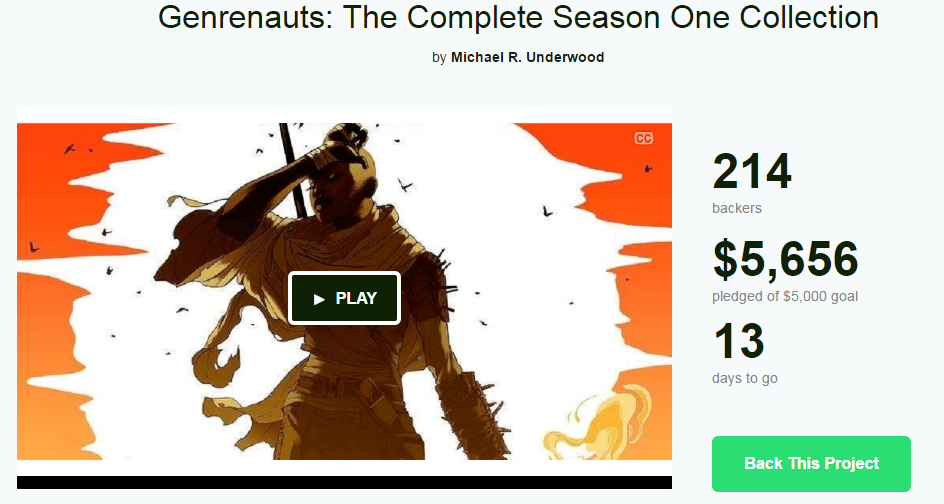
That’s right – the campaign has passed the original funding goal, and now we’re pushing on for the audiobook editions of Episodes 3 and beyond! There’s still time to check out the campaign and get involved. (I’ve added some whimsy-based goals, as well as a limited edition hardcover level).


Also, I will be at BaltiCon this weekend, and if the site is to be trusted, this is my schedule:

Friday May 27, 2016
5:00 PM
Readings: Michael Kangal, Gary L. Lester, Christie Meierz, Michael R. Underwood
Renaissance – St. George
Christie Meierz | Michael Kangal | Gary L. Lester | Michael R. Underwood
Reading 52 minutes


Saturday May 28, 2016

5:00 PM
Sarah Pinsker, Alex Shvartzman and Michael R. Underwood Autographing
Renaissance – Autograph Table 1
Sarah Pinsker  | Alex Shvartsman | Michael R. Underwood
Autographs 1 hour


Sunday May 29, 2016

11:00 AM
Dangerous Voices Variety Hour
Renaissance – Ballroom (MD Salons CD)
Michael Underwood | Sarah Pinsker | Peter S. Beagle | Fran Wilde | Jo Walton | John Picacio
Special Event 1 hour 30 minutes

Monday May 30, 2016

10:00AM
Monday Gimungous Autograph Session
Renaissance – Kent
Autographs 1 hour 30 minutes

12:00 PM
What’s Hot Short Fiction?
Renaissance – Parlor 8029
Sarah Pinsker  | Michael R. Underwood | Jean Marie Ward | Scott Edelman | Alex Shvartsman
Discussion Panel 50 minutes


The New Landscape – Platforms, Crowd Funding, and More

Last November, I wrote a post called The New Landscape – Access, Discovery, and Media De-centralization. I’ve decided to call that essay the first in a series (The New Landscape), and today I want to take the topic in a new direction, jumping off of this point:

Here’s what I see as the dominant progression for a creator trying to make money from their work (visual art, music, prose, comics, video, etc.)

Level 1 – Start small, give stuff away for free, sell some stuff. At Level 1, a creator is almost totally reliant on big systems, for both discovery and fulfillment/delivery. Basically no one knows who they are, so they join larger infrastructures and services to get the word out about their material through algorithmic and organic discovery.

Level 2 – Building Audience & Relationships — At this level, it becomes viable to diversify their portfolio, maybe by selling some merch (T-shirts, mugs, stickers, patches, etc). Here, a creator can bring dedicated fans onto a growing mailing list. This level enables direct sales and stronger performance on retail sites, but the creator may still be largely dependent for discovery-enabled growth and a lot of fulfillment/delivery.

Level 3 – Big Creators – Here, creators have a dedicated audience large enough they can get a living wage directly from their base, either totally direct or through Patreon/Kickstarter. Maybe they supplement their income speaking/appearance fees etc., having a large enough platform that they are in demand not just as creators, but as entrepreneurs/thought leaders in their field. They may still use large systems, but if they do, they do so from a far stronger position – they are less dependent on any given system, since their supporter base is strong, a base that is specific and mobilized, not platform-dependent.

This three-tier system is a bit reductive, as I said in the original post, but it provides a framework for what I’d like to talk about today: the differences between services/systems for Platform Building and those for Platform Mobilization.

At the Nebula Conference, I got to meet with a representative from Patreon, who helped answer some questions I had about their company and business model. Their rep confirmed what I’d already seen from being a patron on that platform – that it is more of a Platform Mobilizing system rather than a Platform Building one.

(Note – a number of writers I admire have found some success already using Patreon to support their other writing-based income, including Saladin Ahmed, Kameron Hurley, and most recently, N.K. Jemisin, who hit and easily passed the goal she’d set to allow her to quit her day job.)

Defining Terms

Here’s what I mean:

Platform: a creator’s established body of work, professional networks, and the way that they present as a creator. A creator with a small platform may just have started releasing works, or they may not have reached a very wide audience. A creator with a large platform may be well-known for some other work before they entered a creative field, or they might have built it as their career developed. A large platform tends to come with and from a large supporter base.

Platform Building: A system or process that is Platform Building is one that includes discovery systems – good ways for people that have never heard of the creator to find them and engage with their works. Producing content is Platform Building, as every work creates the opportunity for someone to find and engage with your creative efforts. YouTube, Twitch.tv, and any retail system where a consumer can follow a creator can serve as a Platform Building system. Platform Building enables creator and consumer/reader/fan to engage through the work as well as enabling other forms of communication to strengthen those relationships.

Platform Mobilizing: A system or process that is Platform Mobilizing is one where a creator can send or bring their fans/readers/viewers/etc. in order to make a project happen or to allow more direct financial support for a project/creator. Kickstarter and Patreon are both Platform Mobilizing companies, though in different ways, to different degrees.

Example – Mobilizing for Genrenauts

I’m running a Kickstarter right now, and as of the time of writing this essay, the project is less than 10% from hitting the $5,000 funding goal (yay!) When I launched the project, I was a bit worried that $5,000 might be too high for a first Kickstarter, that maybe I needed to aim lower and then try to build momentum by over-funding.

But in reality, I hit 50% of the goal in two and a half days, largely based on existing fans and strong signal-boosting from friends and colleagues. Based on how things are going, I’m likely to hit the funding goal about halfway through the campaign, and then spend the final two weeks pushing for stretch goals. That seems like a perfectly solid way of going about things in a single-creator project.

What has surprised me is that according to Kickstarter’s dashboard analysis tools, around 27% of the pledges made to the project have come from Kickstarter’s own discovery systems. Those include their search engine, their Projects We Love recommendations, and so on. I had not expected Kickstarter to provide so much discovery. I’d estimate that close to a third of the backers on the project had not heard of me before launch. This, in my opinion, means that I’d substantially under-estimated Kickstarter’s utility as a tool for not only Platform Mobilizing, but also Platform Building. There are going to be notably more people invested in the Genrenauts series when this campaign completes than when it had started.

Given the opportunities involved, any Platform Mobilizing system that uses a crowd-funding approach like Kickstarter will likely be working on building in some discovery systems. The company benefits if people come to trust their system as a way of discovering amazing new content, and the creators benefit from crowd-funding with a system that helps do more than just facilitate a direct mobilization of existing fans/readers/viewers/etc. And it definitely works for me as a consumer, too – I’ve backed a fair # of projects that I only heard about through Kickstarter’s search system. Patreon’s discovery tools, in my experience, are more nascent, and have a ways to go. The company is also much younger thank Kickstarter, so this is to be expected.

The Inevitable So What

Here’s why I think this is a useful framework: I’ve been following Kickstarter and Patreon each since pretty early in their public histories, and trying to study what they can and do offer to creators. In publishing we have this idea of The Discoverability Problem, which is that it is getting harder for individual creators to have their work discovered, which makes it harder for new creators to find a following and build a sustainable career. There are so many books being released (largely due to digital self-publishing) and more releases means that there are more works to choose from. In publishing, the loss of shelf space from the closing of Borders and the lessening number of indie bookstores in the USA (a trend that has thankfully reversed, as we’re seeing new strong indies doing a great job around the country) means that writers are posed with discovery being an ever-greater problem.

One of the best ways to be discovered is to build your platform. The more people know you and have positive associations with you, the more chances you have to sell your work.

With the proliferation of social media, there are ever-more places creators can go to try to build their platform. You can be on Instagram, Tumblr, or Snapchat, as well as older systems like Facebook, YouTube, Twitter, etc. Social media channels are a well-trod way of building platform – incrementally growing your readership/tribe/etc. by consistently entertaining, informing, or whatever you choose to do. This form of Platform-Building tends to take time and a lot of effort. The first few people to any platform will be far more likely to benefit from it, growing their profile as the platform grows.

But any one media company can come or go – the fortunes of a social media company rise and fall. LiveJournal and MySpace are mere shadows of what they once were. Facebook lists on, and Twitter is harried by largely-unchecked abusers and the continual frustration of not being able to edit a typo out of a tweet that’s raking up RTs.

If a creator gets in deep with a single platform, their ability to connect with their fans/readers/etc. is bound up in that company’s fate. This is why people have been harping on and on about email lists/newsletters – if you bring you audience to a system that is much more directly under your control, that ability to connect is much more robust.

And from a mailing list, you can then direct your fans to a new platform, mobilizing them in order to help make a project happen.

This is why I see Platform Building systems as mostly being oriented toward Stage One and Stage Two (see the framework from the earlier post), and that Platform Mobilizing systems are more effective for later Stage Two and Stage Three. It doesn’t seem terribly viable (at least right now) to start a brand-new creative career by going directly to Patreon as your main way of interacting with fans/readers/etc.. For the most part, the people succeeding on crowd-funding/crowd-patronage systems are those with proven success and/or an existing fan-base. But once you have those connections and have earned that support, systems like Patreon and/or Kickstarter can let a creator provide an opportunity for fans, and especially super-fans, to go the extra mile in supporting a creator.

21st Century Creative Economics

Here’s another way we can express this:

Most of my books are available digital-first, from $2.99 to $5.99 per book. I also have paperbacks for $12.99 to $14.99. I don’t have any books out in hardcover, so $15 is the highest price for any of my books. If I have a super-fan who absolutely adores my works and will buy anything I publish, but I only ever ask $2.99 to $15 for my work, then they’ll buy as many of those as I can produce, but maybe I won’t actually provide them with an opportunity for them to support me to their satisfaction.

Then I launch my Kickstarter, with a $100 backer level, and they pick it in a heartbeat. They get a lot out of being able to directly support me and the extra rewards I offer above and beyond the book. And I get a big chunk of $ toward my project, plus a way to engage directly with a major supporter.

This is, I think, the source of one of the big appeals of Kickstarter and Patreon: With those company’s business models, I can offer a wider range of commercial interaction possibilities, and find places where the existing mix of products doesn’t satisfy a fan/supporter’s interest. If I have a fan who makes a really good living and wants to be able to help support me, if I make it easier for them to get more out of supporting me, we might both be able to win – me from greater financial support, them from getting more content from me, more direct interaction, and/or more insight into how I make my art.

This is another way to diversify your portfolio as a creator – offer a lot of different ways for people to support you – ebooks, paperbacks, audio, crowdfunded support, large-ticket experiences (critiques, Google Hangouts, etc.), and so on. And offering that wider mix you may find that you’re not only making more $, you’re giving readers/fans/etc. more chances to connect with you and your work. The perfect overlap of Platform-Building and Platform-Mobilizing.


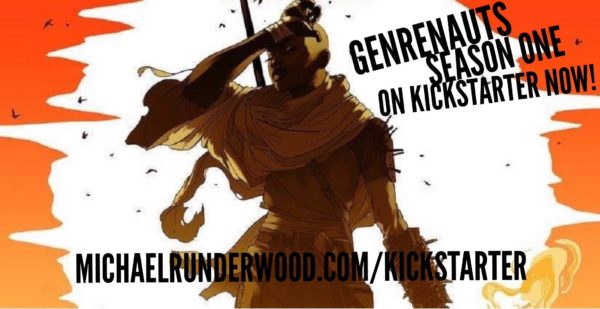
Speaking of that Kickstarter, please check out the campaign and see if you’d like to join over 180 people helping me realize my creative dreams:
Nebulas Recap


Nebula ConferenceLast weekend, I had the fortune of attending the 50th Annual Nebula Awards Conference. I originally wasn’t planning on attending, due to an already-full con schedule, but a friend pitched me on the con, with an intent of having me participate in programming. And the panels being discussed were amazing.
Thanks to the fact that it was a professional conference instead of a consumer show, I managed to avoid coming back totally exhausted. So that’s already a win in my book, considering that I was sick for almost two weeks after C2E2.

A while back, I mused on Twitter that I wanted to see an honest-to-goodness SF/F ProCon, with a professional development focus, integrating self-publishing, traditional, and other hybrid paths. I am very happy to report that the Nebula Conference is in fact such a ProCon.

I attended programming that I wasn’t participating in, including panels on career longevity, Kickstarter, and more. It’s been a while since I attended much programming that 1) I wasn’t participating in or 2) didn’t include friends and AR authors. I usually just hang out and socialize, since not as many panels offer a lot to me these days, unless they’re more advanced in their discussions). And there was so much good programming that the fact that I was on four panel slots meant that there were even more good items that I had to miss.

My other programming highlight was the Ask an Expert sessions, where representatives from KDP, ACX, Patreon, Kickstarter, and other major companies were in attendance and making time for individual discussions. I got a lot of very useful, specific answers to questions I’d had about indie/self-publishing, and feel even more prepared as I move into being a hybrid author.

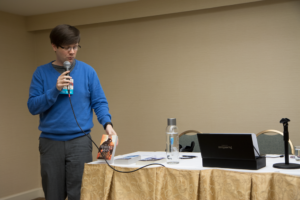
My own programming was some of the best that I’ve been a part of, and audiences seemed to get a lot out of the sessions. We had very good questions and comments from the audience in the Future of Racism panel, and my How To Hand-Sell presentation went over very well, though next year I will definitely want a projector or white-board in order to write out my Hand-Selling flow-chart.

Picture by Zak Zyz

Picture by Zak Zyz

The Moral Responsibility of the Storyteller panel was very powerful, and my fellow panelists and our moderator did a great job of handling a potentially fraught topic with a lot of grace and compassion. My last programming item – promotional boot camp, was incredibly efficient and well-directed, as our moderator (Fonda Lee) solicited questions/topics at the beginning and used those to guide the conversation rather than hoping we’d cover what people wanted to hear about.

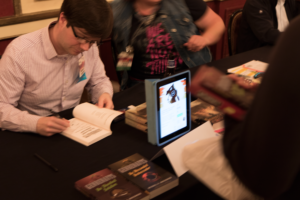
The other big programming item for me was the Mass Autographing session on Friday night, open to the public. I sold several books, signed even more, and got to catch up with several friends. I had my iPad set up with the Genrenauts Kickstarter information to help spread the word and to be one more way for me to draw people to my table. It seemed to work pretty well!

Signing

Since the Nebula Conference moves every two years, it may be harder to build up momentum, and there’s definitely some more work to be done in local outreach to make sure that the autographing sessions reach the largest possible audience. But it was already one of the best signing experiences I’ve had.

And on Saturday night was the Nebula Awards ceremony itself. John Hodgman was a fabulous toastmaster, with a great stand-up set about science fiction, including Dune references, the role that SF/F literature plays in society, and his attempt at pitching a novel to the entire room.

And then the nominees and winners. What an an amazing list of works! It was a great night for Team Once and Future Baltimore, as Fran Wilde took home the Andre Norton Award for her debut Updraft, and Sarah Pinsker (with whom I host Dangerous Voices Variety Hour) won Best Novelette with “Our Lady of the Open Road.”

Fellow Tor.com Publishing writer Nnedi Okorafor won Best Novella for her excellent story Binti, which you should also totally read.

It was a night full of heartfelt appreciation and recognition of the breadth and depth of what SF/F has to offer, and it gave me a lot of hope and excitement for the future of the genre.

I am already thinking about my plans to attend the Nebula Conference next year, when it moves to Pittsburgh. I highly recommend the con to any SF/F writer looking to make connections in the field, participate in SFWA, and/or pursue professional development in craft and/or business skills.


The Genrenauts Complete Season One Collection Kickstarter is going strong, already 80% funded. Help us hit our goal and push onward to audiobook editions!

Kickstarter Card

Genrenauts Episode Three Cover Reveal

I’ve already revealed the cover for The Cupid Reconciliation – Genrenauts Episode Three to my Kickstarter backers, but now it’s time to share it with the world.

This cover was designed by Sean Glenn, with some assets graciously provided by Tor.com so that we could preserve the series style.

Are you ready? Then proceed below the fold…

Continue reading

Nebulas Schedule

Nebula Conference

Hello all!

This week, I’ll be traveling to Chicago for the Nebula Conference, put on by SFWA, the SF/F writers professional guild (I’ve been a proud member for basically my entire professional career).

I wasn’t planning on attending the conference this year, but a SFWA faerie convinced me to attend and present on some programming. Therefore, I’m very excited for what I’ve got lined up during the conference.

You can find my schedule here on the official site, but I’m copying it below for ease of use.

Also, if you’re in Chicago this week but don’t have a ticket for the conference, please check out the Mass Signing on Friday evening, which is open to anyone and everyone.

Thursday, May 12th

3pm – The Future of Racism
Jennifer Cross (Moderator), Liz Argall, Tanya DePass, Michael R. Underwood

The past’s virulent racism against the Irish has now faded to linguistic artifacts like “paddy wagon” and “red-headed stepchild.” What traces will present-day racism leave behind, and what new forms of racism will emerge?

4pm – How To Hand-Sell Your Book
Michael R. Underwood

Lessons from 7 years of hand-selling books to readers, booksellers, and sales reps, for writers looking to learn how to hand-sell their books at conventions or related events.

(I’ve been given a full hour to present on this topic, which means we should really be able to dig deep – I’m also hoping to do some workshopping/role-play to talk through the techniques.)

Friday, May 13th

8:00pm – 9:30pm – Mass Signing
In the Red Lacquer Room

I’ll join the many fabulous attending authors (including Nebula Award finalists!) in a mass signing. This event is open to the public – you do not need to be registered for the Nebulas Conference to attend! Come by and say hello! I’ll have copies of Genrenauts on-hand and will be happy to talk about publishing, my Kickstarter, and/or the many feels Captain America: Civil War gave us.

Saturday, May 14th

2:00pm – 3:00pm – The Moral Responsibility of the Storyteller
Alyssa Wong (Moderator), C.S.E. Cooney, E.J. Fischer, Michael R. Underwood

Society is shaped by narrative. What moral responsibility do storytellers have to consider the larger context in which their work appears? And how do we handle that responsibility, especially when writing outside of our own experiences, or presenting ours when they don’t fit dominant Western (esp. American) narratives or ideas of what a certain story ‘should’ be?

3:00pm – 4:00pm – Promotional Bootcamp
Fonda Lee (Moderator), Patty Garcia, Michael R. Underwood, Ellen Wright

Whether a traditionally published or self published author, you’re told that you need to promote your book. This panel of publicity and marketing professionals takes a hard look at what does and doesn’t work for promoting your work.


Other than these schedule items, I’ll be hanging out chatting with the other attendees – If you’re attending the conference and would like some help meeting people, please feel free to approach me  when I’m out and about – mention this post, and I’ll do my best to help introduce you around.

Genrenauts Kickstarter!

The time has come! The Genrenauts Season One Collection Kickstarter is live, right here.

Kickstarter info card


Check out the campaign for information about the future of the series, backer rewards (including writing critiques and more), sneak peeks at upcoming episodes, and details about stretch goals!

I’ll be appearing on podcasts, giving interviews, and writing guest posts throughout the campaign.

The next chapter of the Genrenauts saga begins…now!


Genrenauts update

Hi everyone! I want to take a minute to talk about what’s next for Genrenauts.

Genrenauts Combined

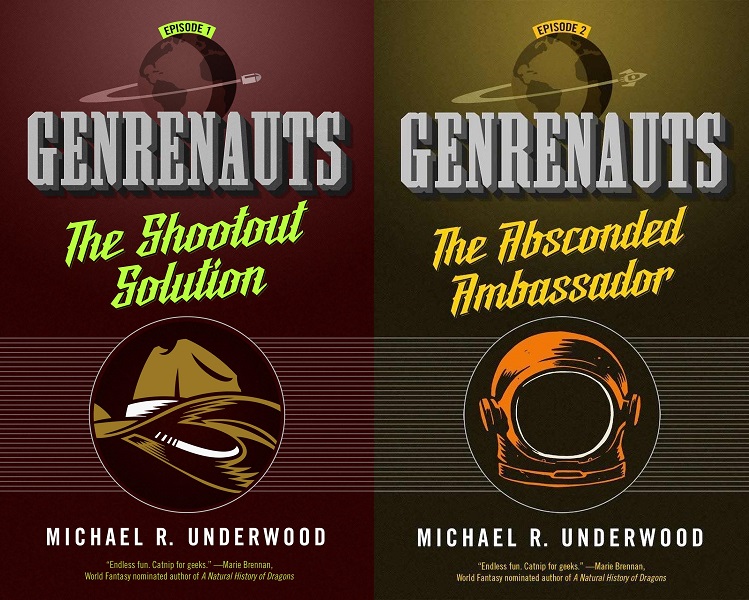
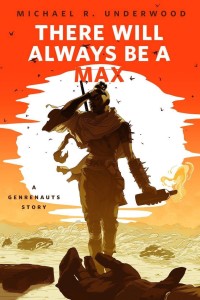
I’ve been very happy to partner with Tor.com Publishing for the first two Genrenauts novellas – The Shootout Solution and The Absconded Ambassador. We’ve also got “There Will Always Be a Max,” a Genrenauts short story, coming April 6th for free on Tor.com.

There Will Always Be a Max cover (by Goñi Montes)

But honestly, I’m champing at the bit to get these stories out to readers. Genrenauts was designed to feel like a weekly TV show or a radio serial, and I want to increase the speed of release to fit that feel. In discussions with Lee Harris, my editor at Tor.com, I realized that they weren’t in a position to publish four more Genrenauts novellas in 2016 in order to get the whole season out this year, so we agreed that I’d go ahead and publish the rest of the season myself. They have been and remain very supportive of the series, which is great.

All six episodes of Season One are written. Episode 3 is already in copy-edits, and Episode 4 is with my developmental editor. I’m looking to have Episode 3 ready to publish by the end of April.


Here’s a preview of what’s coming in the rest of the season:

Episode 3 – The Cupid Reconciliation – Mallery returns to active duty and sparks fly as the team tracks down a story breach in the Rom-Com region.

Episode 4 – The Substitute Sleuth – A scouting mission becomes a scramble to solve a pair of nested mysteries in the Police Procedural region of Crime World.

Episode 5 & 6 – The Failed Fellowship – A two-part season finale where the team travels to Traditional Fantasy-land. Instead of overthrowing the dark lord, the prophesied hero dies before his moment of triumph, and now the Genrenauts have to find a new MacGuffin to defeat the Night-Lord before his arcane power brings about an eternal night of terror.


So that’s what’s coming for Leah and the team. And here’s how we’re going to get there.

The cost of publishing these novellas on my own, to the same standard as Tor.com Publishing has set, will be high. Therefore, I’ve decided to run a Kickstarter campaign to fund a Complete Season One Collection, including Episodes 1-6 and special extras. I’m shooting to launch the Kickstarter in May. And if it funds, there will be ebook and paperback editions of the complete first season. And with stretch goals, possibly even audiobooks for Episodes 3-6. The very flexible contract terms with Tor.com Publishing explicitly allow me to publish this collected edition, and I’m really excited to bring it to life.

I’ll have more information for you about the Kickstarter before it launches, but what I’d love to hear now is this: what extras would you like to see in the campaign? Character dossiers, Genrenauts patches, side mission short stories, playing cards, T-shirts? Your input will help me decide how to make the Kickstarter as awesome as possible.

And if you want to continue supporting Genrenauts right now, the best things to do include:

  • Buying the books.
  • Talking about the series to your book-reading friends.
  • Reviewing the books on retailers and/or Goodreads.
  • Lending the books to people you think might like them.

I’m very grateful for your support on the series so far. I’m really excited for what Episodes 3 and beyond will bring for the series, and to put years of studying indie/self-publishing into practice for myself.


Ebook pricing Storify and the Cult of the Debut

Today just before lunch, I saw this story on Publishers Weekly. Which reminded me of other reports like this one from the New York Times. But there’s a lot to *why* these reported print #s are likely dropping, and a lot these reports leave out. Which is where this discussion started.

I’d also like to say a bit more about the Cult of the Debut. This is a huge thing in publishing. Authors, Agents, Publishers, Reviewers, Booksellers, nearly everyone in publishing is culpable here. We all participate in the Cult of the Debut. The shiny new author, the undiscovered gem, the instant phenomenon new voice that will Revolutionize Publishing, so on and so on. Houses get into huge bidding wars over debuts they think will be the Next Big Thing, spending millions and millions of dollars on an unproven author.

And as authors, we get so worked up about The Big Debut. We see our colleagues getting six, seven figure deals out of the gate, and we despair, thinking we’ll never have the career they’re going to have. We fetishize the Big Debut as the One True Path to writing success? When in reality, a lot of those big debuts fail, and a lot of authors that do end up becoming bestsellers do so by building an audience over time.

VE Schwab just hit the NYT list with A Gathering of Shadows, the second book in a series, and her ninth book overall. She built an audience over six years, bringing her YA audience to her adult series. She has put the work in over time, alongside her publisher, to make this success happen. Stories like Schwab’s are far more achievable, far smarter of a strategy (even with the extraordinary circumstances of her film and TV deals, which are impressive and laudable in their own right), in my opinion, than throwing big stacks of money at debuts and hoping to win the lottery. Schwab has proven her work to be a good investment, has fostered a strong fan base, and now she is reaping the rewards. This is how to succeed without the Cult of the Debut.

Some people do debut right onto the NYT list. My agency-mate Jason M. Hough did with his novel The Darwin Elevator, but that happened because he busted his ass writing all three books in the trilogy so they could be released back-to-back-to-back, so his publisher had all the ammunition in the world to push the book hard. And then? It hit the NYT list probably in no small part to getting a very strong NPR on-air review during drive-time. But there’s no way to guarantee that kind of buzz or support. You make your bets, you give books everything you’ve got, and you pray. Sometimes the magic works, and sometimes, a big advance is the last advance you’ll ever see.

Me? I’m a career slugger so far. I do the work, I write pretty quickly, and I promote the ever-loving crap out of my work by being active online and at conventions. I refine my process, I look at what in my list is working and what isn’t, and I try to focus on writing to where my existing readers are – the pop-culture-savvy action/adventure kind of story.

A lot of writers carve out solid careers for themselves without ever hitting a Bestseller list, without ever getting a major award. They write, they make smart choices about what books to write when, and they find good publishing partners. They develop their careers deliberately, thoughtfully, and by making good bets. Publishers can and often do this, too. But publishers are still frequently distracted by the Cult of the Debut.

And this focus on debuts goes all the way down – Big Debuts get the budget, so they get the support. Which means they get more ARCs, more ads, more events. They get more time during presentations to buyers and librarians, which means they get more exposure to readers and reviewers. All the while, career writers, the long-term proven creators, just hammer out incrementally stronger books, trying to build their audiences organically because they’re not the New Hotness anymore.

We can all do better. Debuts are fun, and it’s exciting to be the person to spread the news about a brand-new author, but there’s a lot to be said for the experience and honed skill of a veteran writer. That’s what I’m hoping to become. It’s not as sexy a role, but it’s far more realistic.


My latest book is The Absconded Ambassador, Episode 2 of the Genrenauts series. The Genrenauts are a group of storytellers that travel to dimensions informed by fiction genres to find and fix broken stories in order to protect their home world.

The Absconded Ambassador

The Genrenauts Life

Life right now is pretty Genrenauts-tastic. I’m working on final edits for Episode 3, Ep. 4 is off for edits soon, etc.

And “There Will Always be a Max,” a Genrenauts short, is coming to Tor.com on April 6th.

There Will Always Be a Max cover (by Goñi Montes)

Which means, with the release of THE ABSCONDED AMBASSADOR very fresh in my mind, I have some things to say and people to thank, which I did largely on Twitter, but will repeat here:

The Absconded Ambassador is dedicated to Dave Robison, an OG (Original Genrenaut), for helping me develop the core premise of the series at a critical juncture, and for his ongoing contributions to the genre in fostering community and helping writers develop their voice and craft.

I lift a Neon Space Drink (TM) to my editor Lee Harris, who took a chance on the series and helped me bring this vision into the world.

I’m also very grateful to Irene Gallo, Christine Foltzer, and Peter Lutjen for creating the cover design and series style for Genrenauts, reflecting the genre love and playfulness of the series.

My Copy-Editor, Amanda Hong, kept the alien species consistent, made sure I kept the timeline clear,  and in general polished the book to look better than it had been before.

Katharine Duckett has done a fantastic job spreading the word about the series and helping me get it into the hands of people far and wide. Thanks also to Mordicai Knode and Carl Engle-Laird for their assistance along the way.

I am so delighted to be a part of the Tor.com Publishing experiment, and the campaign to show that #NovellasAreTheNewNovel.

And speaking of #NovellasAreTheNewNovel, Matt Wallace has been a great supporter of the series, for which I am very grateful. Thanks, brother.

My agent Sara Megibow is the Opener of Doors, the Herald of Awesomeness, always there to help me plow throw when things get rough.

Every book I write is a love letter to the stories that have inspired me, and a suggestion of how we can move forward. As an Ex-Academic, most of my books so far have been my way of taking what I have to say about the genre and the world and putting it into story form. Never has this been more the case than in Genrenauts. I’m really excited about the characters of this series and what they have to say.

Writing Genrenauts has already helped me stretch my skills and learn to write more thoughtfully, more energetically, and more flexibly. (That ONE SECRET FOR WRITING SUCCESS everyone asks about? It’s actually lat stretches. Keep that between you and me.)

And the response so far has been very exciting. Here are some of the reviews for the series:

“This is fun…Readers will be looking forward to Leah and company’s next trip to a story world.”
Library Journal

“It’s an entertaining enough concept, and the diverse cast of characters is a nice change of pace.”
Publishers Weekly

“It’s storytelling as heroism, genre savviness as power. Endless fun.”
Marie Brennan, World Fantasy Award-nominated author of A Natural History of Dragons

“A clever, exciting, and seriously fun twist on portal fantasy that sends a geeky stand-up comedian into the Wild West. Sign me up to be a Genrenaut, too!”
Delilah S. Dawson, author of the Blud series, Hit, and Wake of Vultures, written as Lila Bowen

“My favorite new TV show of 2015 isn’t on TV, it’s in the pages of Mike Underwood’s Genrenauts. Deeply funny and creative, shrewdly insightful, and thrillingly paced, every pop culture diehard will want to keep living vicariously through the characters in this series.”
Matt Wallace, author of the Slingers Saga and Envy of Angels.

“I have this sinking feeling that the Genrenauts series, with its raucous meta-commentary upon the stories of pop culture, is going to say important things that I might not be clever enough to catch the first time around because I’m too busy enjoying the books.”
Howard Tayler, Hugo Award winner and creator of Schlock Mercenary

“…a rollicking exploration of western tropes, with hints of a larger conspiracy afoot. Underwood has plans for a lot more of these, and I can’t wait to read them.”
Joel Cunningham, B&N Sci-Fi & Fantasy Blog

and for Episode 2,

“The second episode in Michael R. Underwood’s Genrenauts delivers on the promise of Episode 1, and demonstrates that his special alchemy of Leverage + The Librarians + Quantum Leap + Thursday Next (just my current guess at his secret recipe) has legs — and will hopefully go a long time.”
– Irresponsible Reader

“…it’s a heck of a lot of fun the way Galaxy Quest is: a little goofy, a little serious but not taking itself too seriously, and filled with a fondness for the source material that gives it weight without weighing down the story.”
Samantha Holloway, New York Journal of Books

it offers a wonderfully creative premise: Fictional stories are really alternate universes in which problems bleed over into our would and cause calamities here.
Leah Hansen, RT Reviews

In closing, I hope you’ll join Team Genrenauts and see where the story goes next.


The latest Genrenauts story is The Absconded Ambassador. Weird aliens, diplomatic wrangling, space dogfights, genre ruminations, and more:

The Absconded Ambassador

My Hamilton Reaction Post

Or: We Got to be in the Room Where it Happened

20160228_143324

So yeah, that happened.

Meg and I visited NYC over the weekend to celebrate my birthday and to take a short vacation. We visited old haunts, explored the vast halls of the Met, and played the Hamilton lottery, just in case.

We lost on Friday, twice on Saturday, but then on Sunday, emerging from the subway as we made our way to Caracas for lunch, Meg looked at her phone and said, in a surprisingly calm voice, “I won.”

I managed to not scream and shout with joy in the corner market where we stopped to buy tickets. There was dancing, however. And it’s really good we decided to hit lunch when we did, since we had a mere 11 minutes to spare when Meg got the lottery notification.

The first thing I noticed walking into the theater itself is that the Richard Rogers is not a large theater. It holds 1,319, but it looks much smaller.

The stage set up is modular and mobile, with rotating floor sections and moving stage fixtures and a balcony in the background:

20160228_145040

Since we had lottery tickets, we were in the front row, on the right hand side of the center section. This meant that we were looking up at the performance the whole time, which helped create a sense of epic wonder – that these performers were larger than life, as was their story.

Because it was a Sunday matinee, the title role was played by Javier Muñoz, rather than Lin-Manuel Miranda. Since I’ve listened to the show’s OST many times, having that major difference helped make the live show a wholly distinct experience. Muñoz’s performance is a bit more Broadway than Manuel-Miranda’s, stronger in the singing and a bit less fluent in the rapping.

Leslie Odom, Jr. is AMAZING as Aaron Burr. I’d already been really impressed by his work as Burr in the few videos I’ve seen and in the OST, but seeing him in person, the passion and polish in his performance totally blew me away. Daveed Diggs as Lafayette/Jefferson is even more hilarious than I’d imagined – Diggs fills moments and elevates scenes with his reactions and fantastic physical comedy. Also worth calling out for delight is Jonathan Groff’s King George, who uses a full range of comedic tools to make his numbers and scenes laugh-out-loud funny, including participating in “The Reynolds Pamphlet,” which I hadn’t realized was part of the show – he dances around the stage celebrating Hamilton’s self-destructive move, along with Jefferson and company.

And if there is any justice, Phillipa Soo will have a long and celebrated career in Broadway, because DAMN she is brilliant. The Schuyler Sisters (Phillipa Soo, Jasmine Cephas-Jones, and Renee Elise Goldsberry) have great rapport, and their number is incredibly fun.

Even having heard the soundtrack several times, the performances moved me to tears twice in act one, and three times in act two.

Other notes from seeing the full performance:

  • Muñoz and Odom Jr. do a great job of portraying the complicated friendship/rivalry/enmity between Hamilton and Burr. Muñoz’s Hamilton shows naked ambition and arrogance in key moments, showing how he alienates the people around him, including those in his closest confidence (Washington, Burr, and his own wife Eliza).
  • There’s much more b-boy and pop & lock in the ensemble’s dance pieces than I thought – it was really cool to see.
  • Jon Rua (an ensemble player and Hamilton understudy, who usually plays Charles Lee) has the most boss undercut I’ve seen. Like, seriously, Undercut Goals. He could be the rival-friend in a martial arts anime.
  • I got a T-Shirt. It’s the “Just Like My Country – Young, Scrappy, and Hungry” and it will be my new Writing Power-Up shirt.
  • If you buy drinks, they come in Hamilton cups. They’re cool, but they’e plastic. I would happily buy Hamilton pint glasses. Can you say strategic partnership with the Sam Adams Brewing Company?
  • OMG HAMILTON!

Of course, now I want to see the show again with Lin-Manuel Miranda, but I may be waiting quite a while. Even having seen the show, I still really want the original cast to do at least one weekend live-cast to movie theaters the way some operas have done. They could charge $25 a seat and make tens of millions in one weekend. The show has legit, Tumblr-level fandom, and a huge % of those fans cannot afford tickets and/or the cost to come to NYC to play the lottery, but are no less devoted. I’ll be interested to see how Miranda and the team continues to deal with the show’s phenomenon status.

Now, back to my regularly scheduled program of singing Hamilton songs to myself as I work.


Mike’s latest book is The Absconded Ambassador – Genrenauts Episode 2. Weird aliens, diplomatic wrangling, space dogfights, genre ruminations, and more:

The Absconded Ambassador